Free Turnitin checker vs official report: what differs

A free Turnitin checker is almost never Turnitin. It is a different engine reading a smaller index, so its percentage can sit twenty points from the score your school will see. An official report comes from Turnitin's own database and lists every matched source.

What the free tools actually run
Most free checkers search pages they can crawl or a pool of open papers. That is a fraction of the index behind your institutional report.
Turnitin's media kit lists 91 billion web pages, 1.9 billion student papers and 190 million journal articles. A free index rarely gets near those numbers.
The gap shows up most on essays built from course readings, lecture notes and last year's submissions.
A free tool also caps the file size and the daily runs, which hides long documents entirely.
What an official report shows
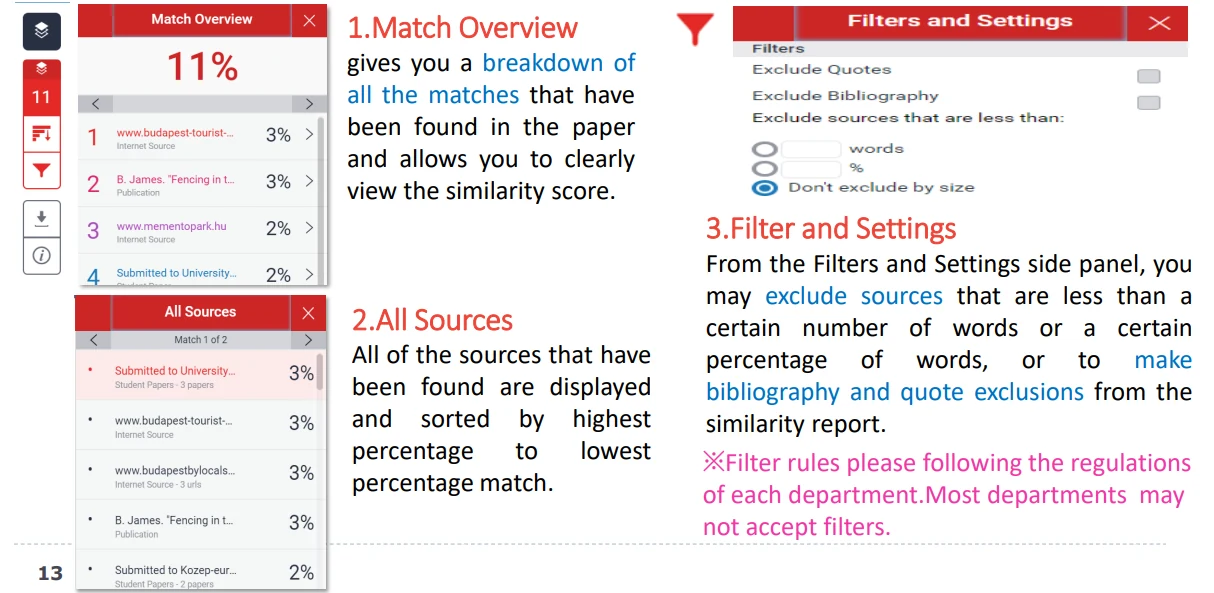
The official view opens with a Match Overview figure and a list titled All Sources, each entry with its own percentage.
A Filters and Settings panel lets you exclude quotes, the bibliography and small matches. Each filter changes the headline number, and your department may accept only one version.
You also get colour bands and highlighted text, so you can see which sentence created the match.
The bands are a reading aid, not a rule. Your department sets the threshold, not Turnitin.
The report is also tied to a date and a file, which matters if a tutor asks when the draft existed.
Where a free check still helps
A free pass earns its place in the early drafting stage, not near submission.
- Confirming that every quote is closed and cited.
- Finding text you pasted from your own notes.
- Spotting paragraphs that read like a source dump.
Use it as a proofreading pass. Do not use it to predict your score.
It is also quick enough to run after every edit, which an official report is not.
The score gap that catches students
One tool says 8%, the official report says 27%, and neither figure is a verdict. Turnitin states that there is no acceptable or perfect score, and a high number alone does not mean plagiarism.
What the detectors measure explains why the same text can move so far between indexes.
When the free number is much lower, do not relax. The matches it missed are usually the ones your school's database exists to find.
Small matches add up. Ten sources at 2% each produce a 20% headline without a single obvious copy.
How to compare the two numbers
Put the two reports side by side and read the sources, not the percentages. If the official list contains a paper your free tool never saw, the gap is explained.
Look for a cluster of small matches from one source. That pattern usually means a paragraph sits too close to a single article.
Then decide what to fix. Rewriting one dense paragraph often moves the score far more than trimming citations.
Ignore any tool that reports a number with no sources. There is nothing to act on.
How to get a Turnitin-quality check
A paid pre-submission service returns a Turnitin similarity and AI report, so you see match groups instead of a bare percentage.
Book that for the version you are about to submit. Early drafts can stay on free checker options.
Read the sample report before you pay. It should look like the one your department prints.
Check how many runs the price includes. One upload is rarely enough after feedback.
FAQ
Is a free Turnitin checker a real Turnitin report?
No. It uses another engine and another index, so the percentage is only a rough signal.
Why is the free score usually lower?
Because the index is smaller. Student papers and paywalled articles, which create many matches, are mostly absent.
Which number should I trust?
The official report your institution runs. It is built on the database your grade depends on.
Check your paper before you submit — you get a similarity score and an AI score in one report.