Invisible Watermarks and Their Impact on Turnitin AI Detection: What You Need to Know in 2026

In August 2026, the AI industry crossed a significant threshold. With the enforcement of Article 50(2) of the EU AI Act — which mandates machine-readable marking of AI-generated content — major AI providers began embedding invisible watermarks into the text, images, and files their models produce. Anthropic led the charge with Claude, followed closely by Google (via SynthID) and OpenAI (via C2PA metadata). These are not cosmetic labels buried in font colors or hidden characters. They are mathematical signatures woven into the statistical fabric of AI-generated text itself.
For educators, students, publishers, and anyone who relies on content integrity tools like Turnitin, this raises an urgent question: How do invisible watermarks affect AI detection — and what does it mean for the future of academic integrity?
This article provides a comprehensive, evidence-based analysis. We'll dissect the technology, clarify widespread misconceptions, and examine the real-world implications for Turnitin's AI detection capabilities.
Part 1: Understanding the Two Fundamentally Different Approaches to AI Content Detection
Before assessing the impact of watermarks on Turnitin, it is essential to understand that "AI detection" and "watermark detection" are two entirely different things — a distinction most guides fail to make clear.
1.1 Type 1: Cryptographic / Statistical Watermarks (Embedded at Generation Time)
These watermarks are embedded during the text generation process by subtly biasing the model's token probability distributions. The AI provider holds a private cryptographic key that can later verify whether a given text carries the watermark.
How it works (using the SynthID-Text approach that Claude adopted):
- Large language models generate text one token at a time. At each step, the model faces choices among multiple plausible words. For example, in the sentence "The weather today was cold and...", both "overcast" and "grey" are natural continuations.
- Without watermarking, the model picks among these options using a standard random number generator.
- With watermarking, the randomness source is replaced by a cryptographic key combined with the preceding context. This creates a hidden statistical pattern across hundreds of word choices — invisible to readers, but detectable by anyone holding the key.
- Crucially, the watermark does not alter meaning, quality, tone, or readability. Anthropic's internal testing confirmed no measurable difference in output quality between watermarked and non-watermarked text. Google DeepMind's original SynthID-Text paper (published in Nature) reached the same conclusion.
| Property | Detail |
|---|---|
| Visibility | Completely invisible to human readers |
| Durability | Survives copy-paste, light editing, cross-platform transfer |
| Detection | Only possible with the provider's private key |
| Scope | Only the model provider (e.g., Anthropic, Google) can verify |
| Cost | No additional tokens, no extra cost |
Current implementations:
- Google SynthID: The pioneer. Deployed at scale across Gemini for text, Imagen for images, Lyria for audio, and Veo for video. Over 10 billion pieces of content watermarked as of May 2026.
- Claude (Anthropic): Since August 2, 2026, all new Claude models ship with watermarking enabled by default. Covers Claude.ai, the API, Claude Code, and Claude Cowork. Cloud partners (AWS Bedrock, Google Cloud, Microsoft Foundry) also transmit text watermarks.
- OpenAI: Has joined the C2PA coalition and implemented content credentials for images. Text watermarking is under development but not yet publicly deployed for ChatGPT text output.
1.2 Type 2: Statistical Detection Patterns (Analyzed After the Fact)
This is what Turnitin, GPTZero, Originality.ai, and similar tools actually use. These detectors do not look for cryptographic watermarks. Instead, they analyze text for statistical fingerprints that are characteristic of AI-generated writing:
- Perplexity: How "surprising" each word choice is. AI text tends to have low perplexity — it consistently picks the most probable next word, creating a smooth, predictable flow.
- Burstiness: The variance in sentence length and structure. Human writing naturally swings between short punchy sentences and long winding ones. AI prose tends to be more uniform, more "metronomic."
- Syntactic patterns: Sentence tree depth, discourse coherence, lexical diversity curves, and paragraph-level structural signatures.
- Stylometric signals: Word choice distributions, grammatical structure consistency, and other subtle regularities.
Modern detectors use ensemble deep learning models (often fine-tuned variants of RoBERTa or DeBERTa) trained on hundreds of millions of labeled text samples. Turnitin's system, for example, breaks documents into sentences and paragraphs, assigning probability scores to each segment — allowing it to flag a document as a mix of human and AI text.
1.3 The Critical Distinction
| Dimension | Type 1: Cryptographic Watermark | Type 2: Statistical Pattern |
|---|---|---|
| Who can detect it? | Only the model provider (holds the key) | Any AI detector tool |
| What tools work? | Provider's private API (not public) | Turnitin, GPTZero, Originality.ai, etc. |
| Reliability | Near-perfect (when key is available) | 62–88% depending on content type |
| Disrupted by rewriting? | Potentially, with significant rewrites | Yes — humanized text scores lower |
| Works on short text? | No — needs statistical significance | Limited — short samples reduce accuracy |
The bottom line: When most people ask "Can Turnitin detect AI watermarks?", they are conflating two separate technologies. Turnitin does not detect cryptographic watermarks. It detects statistical patterns. This distinction is fundamental to everything that follows.
Part 2: The Direct Impact of Invisible Watermarks on Turnitin
2.1 No Direct Integration — Yet
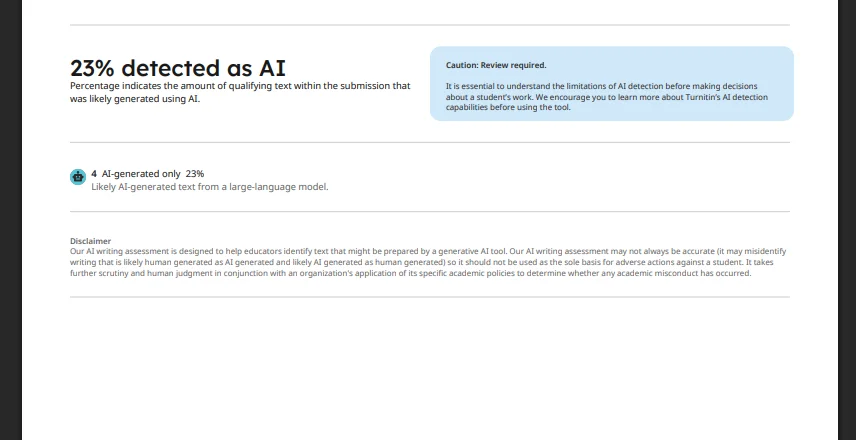
As of August 2026, Turnitin's AI detection operates independently of the cryptographic watermarking systems deployed by Anthropic, Google, or OpenAI. Turnitin does not possess the private keys needed to verify SynthID or Claude watermarks. Its detection pipeline is built on its own proprietary classifiers trained on linguistic patterns, not on reading embedded cryptographic signals.
This means:
- A text with a perfectly intact watermark could still pass Turnitin's detection if the writing style happens to mimic human patterns closely enough.
- Conversely, a text with a broken or absent watermark (e.g., from an older model, or after heavy rewriting) could still be flagged by Turnitin if its statistical fingerprints match AI-generated patterns.
The watermark and the detector are operating on parallel but independent tracks.
2.2 Indirect Effects: Where Watermarks and Detectors Converge
However, the relationship is not entirely independent. Several indirect effects are worth noting:
Signal Reinforcement. Watermarked text, by definition, carries a statistical bias in its word choices. While this bias is designed to be imperceptible, it is a form of pattern — and patterns are exactly what Turnitin's classifiers look for. In theory, the presence of a watermark could reinforce the statistical signals that Turnitin's detectors are already scanning for, making watermarked text slightly easier to flag. However, neither Anthropic nor Turnitin has published research confirming the magnitude of this effect.
Metadata as a Complementary Signal. While Turnitin doesn't currently read C2PA metadata, the broader industry trend is toward multi-layered provenance verification. It is plausible that future versions of Turnitin — or competing tools — could incorporate C2PA content credentials as an additional signal alongside their existing classifiers. C2PA is an open standard (supported by Adobe, Microsoft, Intel, and others), so unlike cryptographic text watermarks, anyone can read C2PA metadata without a private key.
Behavioral Shifts in AI Models. As AI providers optimize their models to produce more "human-like" statistical patterns (partly to improve user experience, partly to reduce detection), they may inadvertently affect how well Turnitin's classifiers perform. The watermarking process itself doesn't change text quality — but the broader evolution of model architectures does. This is the moving target problem that the RAID benchmark (University of Pennsylvania, ACL 2024) documented extensively: detectors trained on one generation of models become less effective against the next.
2.3 Scenario Analysis: Watermarks vs. Turnitin Detection
| Scenario | Watermark Status | Likely Turnitin Detection |
|---|---|---|
| Pure AI-generated text, no editing | Intact | High — strong statistical AI patterns |
| AI-generated + heavy paraphrasing | Likely degraded | Medium — statistical patterns disrupted |
| AI-assisted brainstorming + substantial human writing | Present but weak signal | Low–Medium — depends on human contribution ratio |
| Very short text (<100 words) | Statistically insignificant | Low — insufficient sample for either method |
| AI text run through a "humanizer" tool | Likely degraded | Variable — depends on humanizer quality |
| Text from pre-August 2026 Claude models | No watermark | Unchanged — Turnitin detects via patterns, not watermarks |
Part 3: The Broader Industry Landscape
Claude's invisible fingerprint is not an isolated experiment. It is part of a global industry shift toward content provenance infrastructure — driven by both regulatory mandates and technical necessity.
3.1 Major Players and Their Approaches
Google (Gemini / DeepMind): The Pioneer
- SynthID is the most mature watermarking system in production. It covers text, images, audio, and video.
- Google has built a built-in detection capability directly into Gemini: users can upload an image, video, or audio file and ask whether it was generated or altered by Google AI.
- As of May 2026, over 10 billion pieces of content have been watermarked with SynthID across Google's generative AI products.
- In a notable collaboration, OpenAI and Google partnered to embed SynthID watermarks into images generated via ChatGPT, DALL·E, and the OpenAI API.
Anthropic (Claude): The Strictest Compliance
- Anthropic adopted the most stringent interpretation of the EU AI Act: watermarking is globally applied, not limited to EU users.
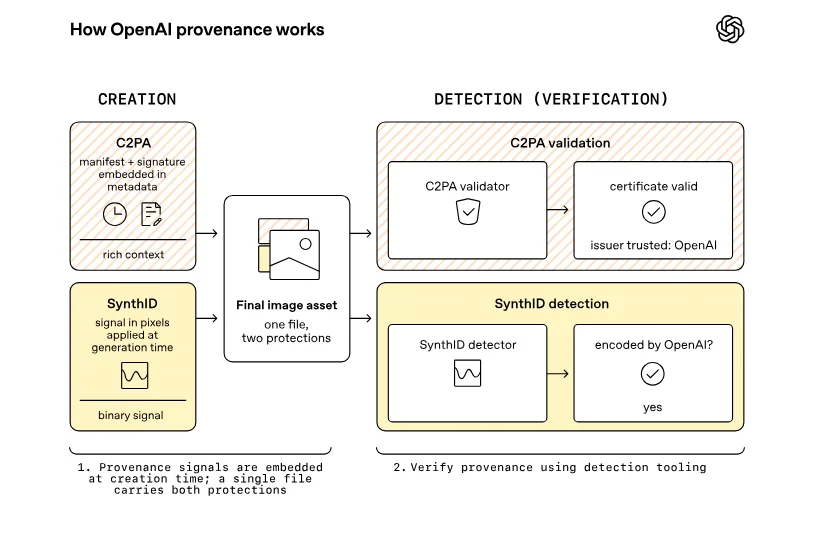
- The system uses a variant of SynthID-Text for text output and C2PA metadata for files (images, documents).
- Anthropic has been unusually transparent about the technology, publishing detailed technical explanations and openly acknowledging limitations.
OpenAI (ChatGPT / DALL·E): The Metadata Approach
- OpenAI joined the C2PA coalition and became a "compliant generator product."
- DALL·E and ChatGPT-generated images already carry C2PA content credentials by default.
- For text, OpenAI has taken a more cautious approach. Internal research on text watermarking was reportedly conducted but not publicly deployed, citing concerns about robustness, user backlash, and false positive risks.
- Independent researchers have observed invisible Unicode characters (e.g., Narrow No-Break Space U+202F, Zero-Width Space U+200B) in output from newer models like GPT-4o, though OpenAI has not confirmed these as intentional watermarks.
Chinese AI Providers: Mandatory Labeling Under Strong Regulation
- In China, AI content labeling is not optional — it is a legal requirement under the Interim Measures for the Management of AI-Generated Synthetic Content (effective September 2023) and subsequent regulations.
- Major platforms (Tencent, ByteDance/Douyin, Kuaishou, Bilibili, Baidu, Alibaba/Qwen, DeepSeek) have all implemented dual-layer labeling:
- Explicit labels: Visible "AI-generated" badges on images and videos.
- Implicit labels: Invisible watermarks embedded in file metadata or text.
- If creators fail to self-declare AI content but platforms detect implicit markers through technical verification, the platform will force-add an "AI-generated content" notice.
- The China Software Testing Center has established evaluation capabilities to ensure compliance with national mandatory standards.
3.2 The Unifying Standard: C2PA
The Coalition for Content Provenance and Authenticity (C2PA), founded by Adobe, Microsoft, Intel, and BBC, is emerging as the universal standard for content provenance.
- Unlike cryptographic text watermarks (which require a private key), C2PA metadata is an open standard — anyone with the right tools can read it.
- C2PA attaches a cryptographically signed "content credential" to files — essentially a digital passport that records who created the content, what tools were used, and whether it has been modified.
- Major tech companies (Google, OpenAI, Anthropic, Adobe, Microsoft) have all joined the coalition.
- The vision: in the future, any piece of digital content could be verified through a universal tool — similar to how HTTPS certificates verify website authenticity today.
Part 4: Limitations and Real-World Challenges
No technology is a silver bullet. Both invisible watermarks and statistical AI detectors have significant limitations that must be understood — especially in high-stakes contexts like academic integrity.
4.1 Limitations of Invisible Watermarks
1. Proves "Involvement," Not "Authorship"
A detected watermark only indicates that Claude (or another AI) processed the text. If a user submits a human-written essay and asks Claude to proofread, translate, or summarize it, the output will still carry a watermark — even though the core ideas are entirely human. As Anthropic itself states: "A detected watermark is not definitive proof that Claude originally authored the entire document."
2. Short Text and Heavy Rewriting
Watermarks rely on statistical patterns that require sufficient text length to achieve significance. Very short outputs (a few sentences) may not contain enough signal for reliable detection. Similarly, heavy paraphrasing, translation, or mixing with text from other sources can degrade or destroy the watermark.
3. File Metadata Is Fragile
C2PA metadata lives in the file container, not in the content itself. If a user takes a screenshot of a watermarked image, converts it to an unsupported format, or uploads it to a social media platform that strips metadata during compression, the provenance information is lost.
4. The Key-Holding Problem
Cryptographic text watermarks can only be verified by the entity holding the private key. This creates a centralized trust model: third parties (including Turnitin, educators, or journalists) cannot independently verify the watermark. Anthropic has announced plans for a public detection API, but as of August 2026, this infrastructure is still being rolled out.
4.2 Limitations of Turnitin's AI Detection
1. False Positives Remain a Real Problem
Even the best AI detectors in 2026 have a false positive rate of approximately 3%. While this sounds low, Turnitin processes over 100 million papers annually — meaning millions of students could be wrongly accused of using AI. Early detectors (2023) had false positive rates as high as 26%.
2. Cross-Model Generalization Is Weak
The RAID benchmark (ACL 2024) found that detectors trained on ChatGPT output were "mostly useless" at detecting text from other models like Llama. Detectors trained on news articles fell apart when tested on recipes or creative writing. As new AI models enter the market — each with different writing patterns — detectors must constantly retrain.
3. Cannot Distinguish "AI-Assisted" from "AI-Generated"
Like watermark detection, Turnitin's statistical analysis cannot determine the degree of AI involvement. A student who used AI for brainstorming and then wrote the entire essay themselves may receive the same flag as a student who submitted raw ChatGPT output.
4. The "Humanizer" Counter-Industry
A growing ecosystem of tools — sometimes called "AI humanizers" — specifically rewrites AI-generated text to evade detection. These tools exploit the same statistical patterns (perplexity, burstiness) that detectors rely on, introducing deliberate variability to mimic human writing. Turnitin responded in August 2025 with "AI bypasser detection," but the cat-and-mouse game continues.
4.3 The Cat-and-Mouse Game
The emergence of invisible watermarks has not stopped the counter-industry. If anything, it has accelerated it:
- Open-source removal tools: The GitHub repository watermarks-remover (11,000+ stars) appeared on the same day Anthropic published its technical watermarking explanation. It offers three-layer removal: Unicode character cleaning (reliable), statistical watermark rewriting ("best effort"), and C2PA metadata stripping (reliable).
- AI humanizer services: Tools like Phrasly, Humanizer.ai, and others specifically market themselves as solutions for making AI text undetectable.
- Prompt engineering: Users are increasingly trained to ask AI models to "write in a human style," "vary sentence length," or "add personal anecdotes" — strategies that disrupt both watermark patterns and statistical detection signals.
Part 5: What This Means for Different Stakeholders
For Students and Educators
- A watermark is not proof of cheating. Detection of a Claude watermark only means Claude was involved in processing the text — it does not prove the student didn't contribute original thought.
- Turnitin's AI score is a signal, not a verdict. It should always be combined with human judgment, knowledge of the student's typical writing style, and consideration of the assignment context.
- Transparency is the best policy. Institutions that establish clear, nuanced AI-use policies (distinguishing between acceptable AI-assisted brainstorming and unacceptable AI-generated submission) will fare better than those relying solely on detection technology.
For Content Creators and Publishers
- Provenance is becoming infrastructure. Just as HTTPS became a baseline expectation for web security, content provenance (via watermarks and C2PA) is on track to become a baseline expectation for digital content authenticity.
- Disclosure builds trust. Proactively labeling AI-assisted content — rather than waiting to be caught — is likely to become a professional norm and, in some jurisdictions, a legal requirement.
For Developers and API Users
- Watermarks are transmitted through cloud platforms. If you call Claude via AWS Bedrock or Google Cloud, text watermarks still apply. C2PA metadata support depends on the specific cloud implementation.
- Older model endpoints may not carry watermarks. Claude models released before August 2, 2026 are in a transition period. Developers who have locked to older API endpoints may not see watermarks in the short term — but this gap will close as Anthropic updates legacy models.
Part 6: The Future of AI Content Detection
Near-Term (2026–2027)
- More AI providers will deploy watermarks. The EU AI Act's enforcement is driving industry-wide adoption. Expect OpenAI to publicly deploy text watermarking, and Chinese providers to further refine their mandatory labeling systems.
- Turnitin may integrate C2PA metadata as a supplementary signal alongside its existing classifiers. This would allow it to verify file-level provenance without needing access to private cryptographic keys.
- Academic institutions will develop clearer AI-use disclosure norms, moving away from binary "allowed/banned" policies toward nuanced frameworks that acknowledge AI as a tool.
Medium to Long-Term (2027+)
- Watermark standardization and interoperability. The C2PA ecosystem may evolve to support cross-provider verification, allowing a single tool to check content against watermarks from multiple AI providers.
- "AI origin labels" become ubiquitous. Checking whether content was AI-generated — and by which provider — could become as routine as checking for an HTTPS lock icon in a browser.
- Detection shifts from "Is this AI?" to "How much AI?" As the technology matures, the question will evolve from binary classification to provenance spectrum analysis — quantifying the degree and nature of AI involvement in content creation.
Conclusion: Watermarks Change the Game — But Not in the Way You Might Think
Invisible watermarks do not directly enhance Turnitin's detection capabilities. Turnitin does not read cryptographic watermarks, and the presence or absence of a watermark does not automatically change its AI detection score.
But the broader implications are profound.
The deployment of invisible watermarks marks the AI industry's transition from an era of untraceable generation to one of verifiable provenance. It signals a future where digital content carries its origin story — not as a visible stamp, but as a mathematical property woven into the content itself.
For Turnitin and similar detection tools, the challenge is not whether to adopt watermark detection, but how to integrate multiple layers of evidence — cryptographic watermarks, C2PA metadata, statistical pattern analysis, and human judgment — into a coherent, fair, and transparent assessment framework.
The technology is here. The standards are forming. The regulations are enforceable. The question is no longer whether AI-generated content will be traceable — but how we, as a society, choose to use that traceability.