iThenticate vs Turnitin: which one do you need?

iThenticate and Turnitin run the same core similarity technology, so the scores are close. The difference is who each one serves. Turnitin is licensed to schools for student work, while iThenticate is sold to researchers, publishers and individuals.

Who each product is built for
Turnitin arrives through a course: a class, an assignment, a deadline, and a tutor who can open the report.
iThenticate is a workspace for authors. You upload a manuscript, read the similarity report, and revise before sending it to a journal.
Same engine, different queue. The guide to Turnitin covers the institutional side in more depth.
The buyer differs as well. A library buys thousands of seats, while an author buys one report at a time.
Price and access
Turnitin does not sell individual licences at all. Access comes only through an institution.
iThenticate does sell to individuals: USD 125 for a single manuscript, or USD 300 for up to 3 manuscripts and 75,000 words, valid 12 months.
Neither product charges per page, which matters once you start comparing quotes.
Individual credits do not include AI writing detection. iThenticate lists what each package contains.
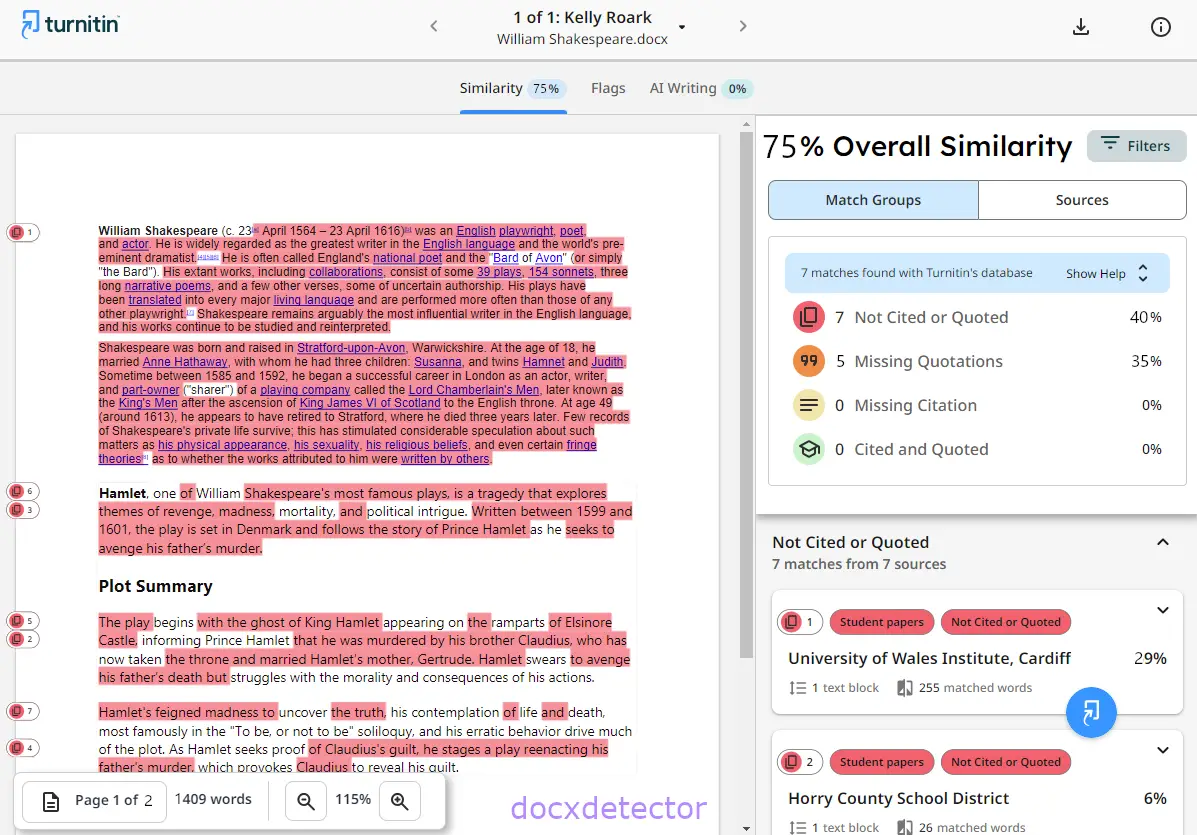
What each report looks like
A Turnitin report lives inside a class folder. Your tutor sets the filters, and you see the version they release.
An iThenticate report arrives in your own account. You choose the exclusions and you keep the file.
That control is the main gain for an author, and it explains why one text can produce two slightly different percentages.
What the two reports share
Both show a similarity percentage, an ordered source list and highlighted matches. Both let you exclude quotes and the bibliography.
Neither score is a plagiarism verdict. Turnitin says there is no acceptable or perfect percentage, and a long reference list can lift the figure on its own.
That is why a number is a starting point for reading, not a result.
Where AI detection separates them
Turnitin's AI writing detector covers 7 languages: English, Spanish, Japanese, Arabic, German, Dutch and Turkish.
Only the English detector includes AI paraphrasing and AI-bypasser detection. The Spanish and Japanese detectors do not.
On iThenticate, AI writing detection is not part of an individual credit, so a solo author should not expect an AI percentage from that purchase.
A high AI percentage never raises similarity, and a low similarity score says nothing about AI.
Which one fits your task
Start from who receives the report, then check what the price includes.
- Class assignment with a tutor watching: Turnitin through your school.
- Journal manuscript or research report: an iThenticate credit.
- Student who needs a score before a deadline: a paid pre-submission check.
If you need both an AI score and a similarity score for one file, a paid pre-submission check covers both, while one iThenticate credit covers similarity only.
Can you use both?
Yes, and some authors do. A student can submit through the class and buy one manuscript credit for a journal paper.
The scores will differ slightly because the settings differ. Treat them as two views of the same text.
Neither replaces your own reading of the sources.
FAQ
Are the similarity scores identical?
Close, not identical. Both read the same core database, but the report settings and the submission route differ.
Can a student buy iThenticate credits?
Yes. iThenticate sells to individuals, so a student can buy one manuscript credit without an institution.
Does iThenticate include AI detection for individuals?
Not with individual credits. AI writing detection is excluded from that purchase.
Check your paper before you submit — you get a similarity score and an AI score in one report.