AI Humanizers vs Turnitin: What the Report Shows

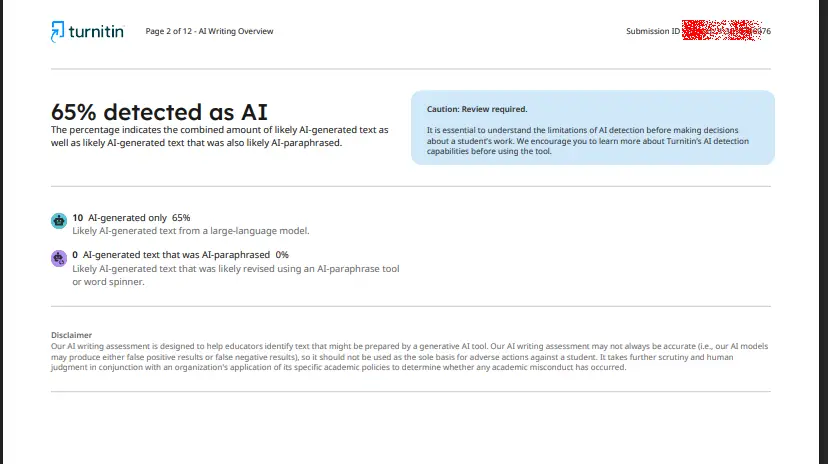
AI humanizers rewrite text so it sounds less machine-made, and Turnitin's English detector includes AI-bypasser detection aimed at exactly that. Results vary by document and by tool. No humanizer can promise a clean report, and here is why.
What a humanizer actually changes
Most humanizers swap vocabulary, break sentences and add small imperfections. Some reorder whole paragraphs or inject casual phrasing.
None of them can add the thing a detector struggles to score: knowledge that came from your own reading, lab work or placement.
So the rewrite changes surface style. It does not change where the content came from, and the report still reflects the submitted file.
Price is not a signal of quality here. Free and paid tools run similar rewriting steps.
Turnitin's bypasser detection
Turnitin lists AI-bypasser detection as part of its English model, alongside AI paraphrasing detection. That is a direct response to tools marketed as detector-proof.
The English detector is the only one with this capability. Spanish and Japanese detectors do not include paraphrasing or bypasser detection.
Seven languages are supported overall: English, Spanish, Japanese, Arabic, German, Dutch and Turkish. Coverage of humanizer output is not equal across them.
Detection also looks at the document as a whole. One humanized paragraph inside machine text rarely moves the headline number.
Why results are unstable
Humanizers are trained to beat a detector, and detectors are retrained after each round. A tool that worked last term may fail this term.
Two paragraphs from the same document can land on different sides of the line. Scores from 1 to 19 percent are shown as an asterisk with no percentage and no highlights.
Turnitin says its false-positive rate is under 1 percent for documents with more than 20 percent AI writing. That is a claim about strong signals, not a promise about your draft.
Anyone selling a guaranteed result is guessing. The honest answer is that the score can go either way.
Scores also move when Turnitin updates its model. A result from last semester tells you nothing about this one.
The risk that is not on the report
A humanized paragraph often loses precision. Technical terms get simplified and hedges disappear, which shows up in your marks rather than your AI score.
Your tutor also reads for voice. A paper that swings between polished prose and casual filler reads as two authors, and that question is harder to answer than a percentage.
Institutions are adding their own rules too. EU AI Act Article 50 transparency obligations apply from 2 August 2026, and Anthropic announced text watermarking for Claude output in August 2026.
Watermarking in the source text is a separate signal from the score. It is covered in invisible watermarks and Turnitin AI detection.
Keep a record of what you changed. A list of edits is easier to defend than a claim that you wrote every word.
A safer way to lower the score
Rewrite from your own notes and add evidence only you have. A sentence built on your data does not need to be disguised.
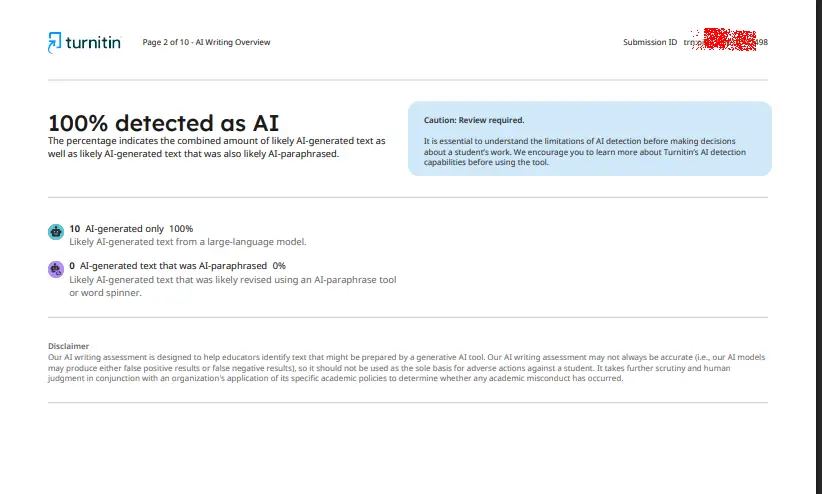
Then check the result before you submit, so you know what the marker will see. A full report gives you a percentage and highlights, not an asterisk and a guess.
Start with the paragraphs the report highlights, not the whole document.
For the mechanics, read the Turnitin AI detection guide.
FAQ
Can an AI humanizer get past Turnitin?
Sometimes the score drops and sometimes it does not. No tool can promise the outcome, because the detector is updated against these tools.
Does Turnitin detect humanizer output in every language?
No. AI-bypasser detection is part of the English detector only, so other languages behave differently.
Is using a humanizer a misconduct risk?
It can be. Many institutions treat disguising AI text as a separate offence from using AI in the first place.
Check your paper before you submit — you get a similarity score and an AI score in one report.