How to Cite ChatGPT in APA, MLA and Harvard Style

All three styles treat ChatGPT output as material you did not write, so it needs an entry and an in-text citation. APA names the model maker as the author. MLA treats the output as a source you must verify.
Harvard follows your institution's variant, so check your library guide for the exact wording.
APA: the model maker is the author
APA treats the company behind the model as the author. The entry names the model, a version, the year, and a URL.
The reference takes this shape: OpenAI. (2026). ChatGPT (version) [Large language model]. https://chat.openai.com. Replace the version with the one you actually used.
In the text, cite the author and the year, for example (OpenAI, 2026). If you quote output word for word, add a paragraph number or describe the prompt. APA publishes its own guidance at apastyle.apa.org.
MLA: treat the output as a source
MLA asks you to cite the specific output you used, not the tool in general. The entry describes the prompt, the model, the date, and the URL.
MLA also expects you to verify anything the model states. AI output is not a source of facts, so check each claim against a real reference before you rely on it.
The style body's advice sits at style.mla.org. Follow that page rather than a citation generator.
Harvard: check your institution's variant
Harvard is not one single published style. Universities publish their own versions, and the wording for AI output differs between them.
Most variants ask for the model name, the version, the company, the year, and the URL or access date. Use the order your library lists, because a marker will check against that page.
What to include either way
- The model name and the version you actually used.
- The company behind the model.
- The year, and the full date if your style asks for it.
- The URL, or a note on how you accessed the tool.
- The prompt, when the output depends on it.
APA uses (OpenAI, 2026) in the sentence. MLA uses a shortened title or the prompt in place of a page number. Harvard variants usually follow the author date pattern of the model maker.
Describe how you used the tool
A citation shows where text came from, but not what you did with it. Add one sentence that states whether the model drafted, edited, or only suggested ideas.
That sentence protects you when a marker compares your process with your final text.
Why a citation does not settle the AI question
A correct citation shows where text came from. It does not make AI-assisted writing acceptable for a specific assignment, because your course policy decides that.
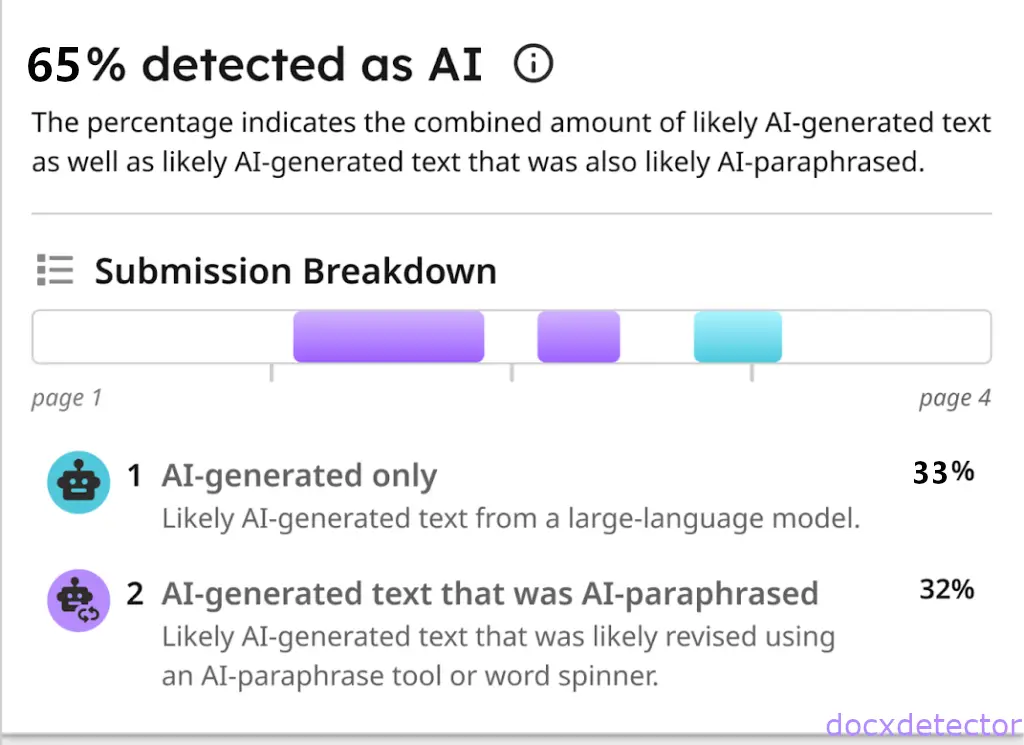
Turnitin's AI report is a separate check with its own percentage. Our guide to Turnitin AI detection explains what that number covers. These strategies for keeping your own voice help when you edit AI-assisted drafts.
Save the prompt, the date, and the version for any output you cite. A marker may ask how the text was produced, and the record answers that in one place.
Screenshots work, but a plain text note is easier to search later.
FAQ
Do I cite ChatGPT if I only used it to brainstorm?
Check your course policy first. If the output shaped your argument, most styles expect a note describing how you used it.
Can I list ChatGPT as a co-author?
No. APA and MLA both require a human author, so the model is cited as a tool or a source, never as an author.
Which version number should I use?
The one shown in the tool when you used it. Versions change, and the entry should match the model that produced your output.
Check your paper before you submit — you get a similarity score and an AI score in one report.