Similarity vs AI Score: Two Numbers With Different Jobs

Both numbers appear in the same Turnitin report and measure different things. The similarity score compares your text with sources, while the AI score estimates how much prose looks machine-generated. Turnitin says the two are independent and do not influence each other.
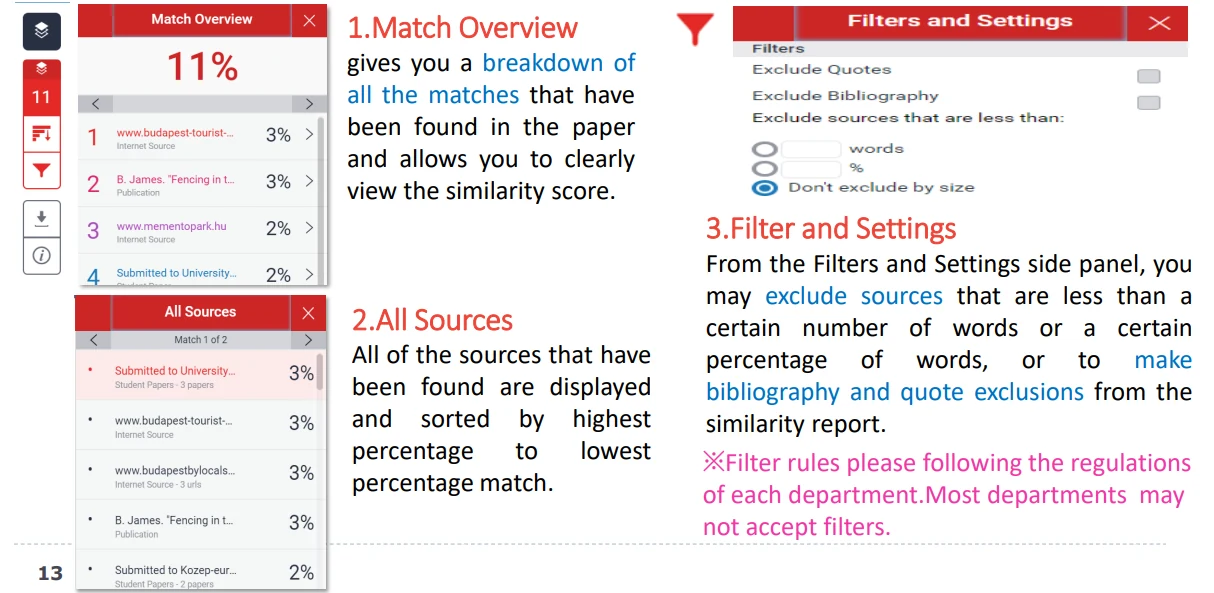
Side by side
| Question | Similarity score | AI writing score |
|---|---|---|
| What it compares | Your text against web pages, student papers and journal articles | Your prose against patterns typical of AI-generated writing |
| Reported as | Share of matching text | Share of prose flagged as AI |
| What it needs | At least one matchable source | 300–30,000 words, a supported language, .docx / .pdf / .txt / .rtf, under 100 MB |
| Small results | Shown as a plain percentage | 1–19% shows an asterisk with no highlights |
Each row answers a different question. The two figures never add up to anything, because they are not measuring the same thing.
Why one can be high while the other is low
A heavily cited essay can sit at 30% similarity and 0% AI, because the matches are quotations and references. A polished AI draft you rewrote in your own words can sit at 2% similarity and a high AI figure.
Both patterns are normal. Neither number explains the other, and fixing one does not move the other.
No pass mark exists for either figure. Your department decides what the numbers mean for your work.
What each score is really measuring
The similarity score only finds text that exists somewhere in Turnitin's collections. Original analysis that nobody else has written scores low by design.
The AI score comes from a judgement about style rather than a lookup. The detector reads the prose and estimates how much of it resembles the patterns it learned.
That difference explains the file rules. An AI Writing Report needs 300–30,000 words and a supported language, while a similarity report only needs text to compare.
Because it never searches for sources, it can flag text that matches nothing at all. That is why the two columns disagree so often.

Read them in this order
- Open the similarity report and check the source list.
- Check Match Groups for uncited and missing matches.
- Open the AI report and read the highlighted passages.
Three steps take a few minutes. Skipping the first one is how students end up rewriting text that was correctly cited all along.
If the AI report will not generate at all, check the file first. The detector needs prose in a supported language, so a scan or a very short file returns nothing.
Which number should you fix first
Start with similarity when the matches are copied blocks, because citations and rewriting solve those. Start with the AI score when the wording is yours but the report still flags it.
Do both before the deadline. A rushed rewrite of one problem often creates the other.
Turnitin's AI detection FAQ explains the limits of the second number. The background in Turnitin AI detection covers how the report is built.
Neither number comes with an accepted cut-off. Treat the similarity score question and the AI percentage as signals for your tutor to read, not as grades.
FAQ
Can a high similarity score raise my AI score?
No. Turnitin calculates the two separately, and one does not feed the other.
Which number do tutors look at first?
Usually the similarity score, because the matches are concrete and easy to open. The AI percentage comes with more caveats and often needs a conversation.
Why does my AI report show an asterisk?
Scores between 1% and 19% are shown as an asterisk with no highlights, because false positives are more common in that range. Treat it as a signal, not a verdict.
Check your paper before you submit — you get a similarity score and an AI score in one report.