Turnitin in China: Why International Students Can No Longer Bypass It Now That AI Detection Is Live

Domestic universities use CNKI for plagiarism checking, but over 500,000 students studying abroad annually, students in Sino-foreign cooperative programs, and researchers submitting to international journals ultimately face Turnitin. After Turnitin launched AI writing detection in April 2023, "Turnitin AI detection" transformed from a niche need into an essential requirement.
This article uses public, verifiable data to clarify three things: the actual use cases of Turnitin in China, how AI detection actually makes determinations, and how Chinese students can conduct compliant self-checks. All numbers mentioned can be verified through sources listed at the end; no speculative or fabricated data is included.
I. A Counterintuitive Fact: Turnitin Actually Has Massive Usage in China
When mentioning plagiarism checking, domestic students instinctively think of CNKI. That's not wrong, but it's only half the story.
Chinese dissertations go through the three major domestic systems:
- CNKI: Launched "AIGC Detection Service System" in September 2023, identifying AI-generated content through language patterns and semantic logic;
- Wanfang: Released "Wanfang Wencha V1.0" on September 20, 2023, with built-in AIGC detection module;
- Weipu: Launched AIGC detection service in November 2023.
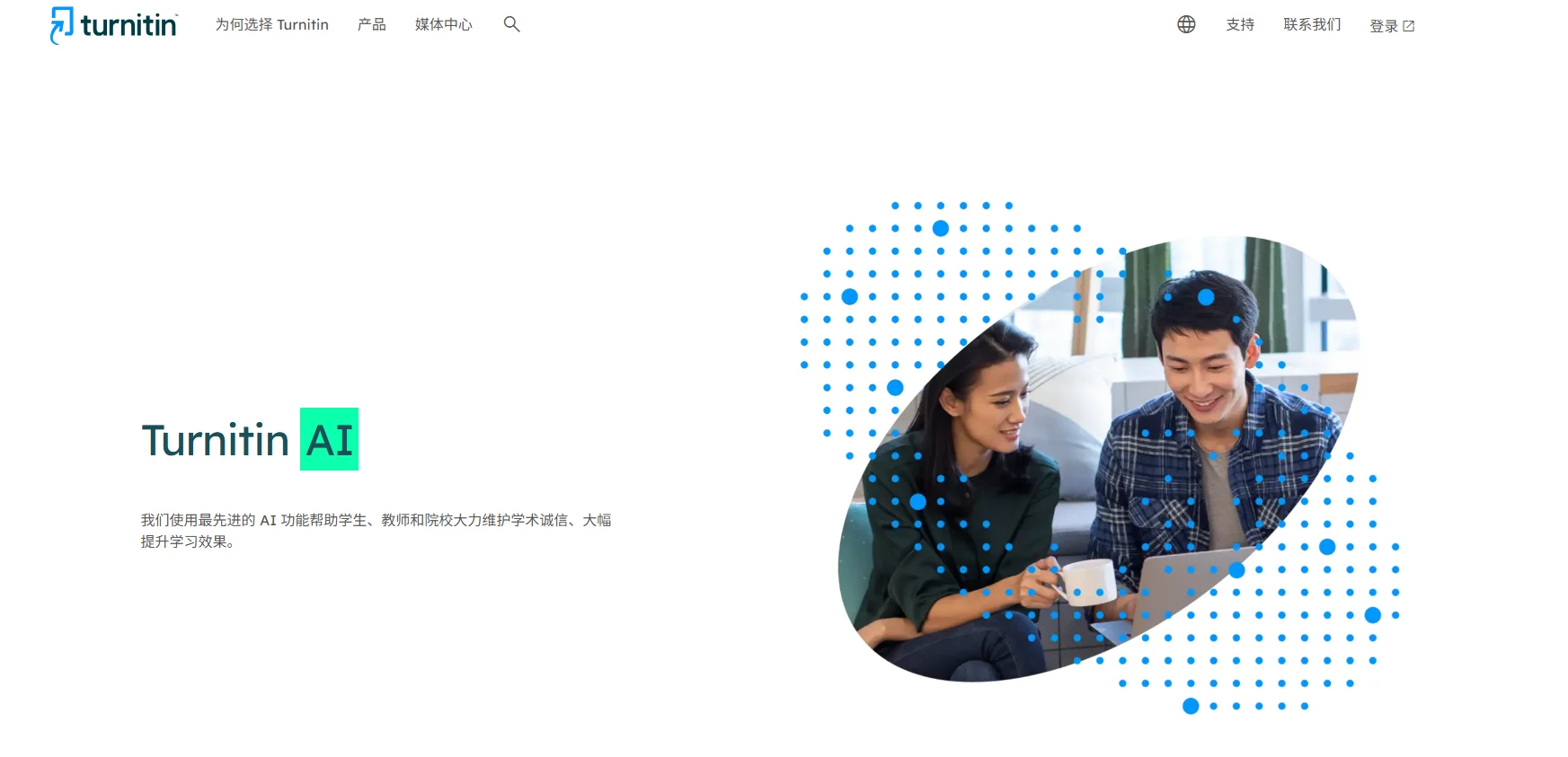
English papers, international student assignments, and international journal submissions use Turnitin. According to Turnitin's official media kit, its services cover over 16,000 institutions, more than 185 countries and regions, and over 71 million students, with a database containing over 91 billion web pages, more than 1.9 billion student papers, and over 190 million journal articles (data updates with official pages; refer to official sources for accuracy).
In other words, if you meet any of the following criteria, your assignment submission system is Turnitin, not CNKI:
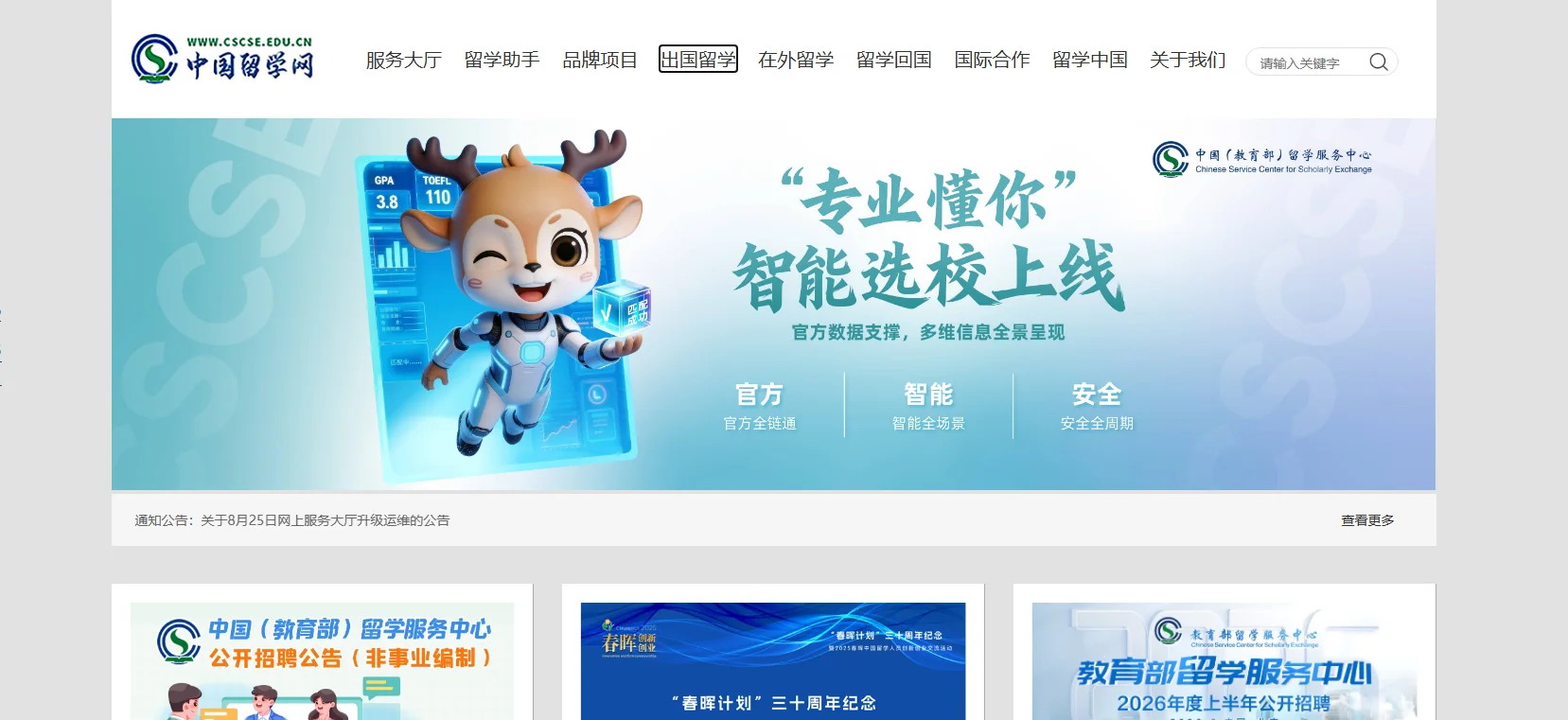
- Studying abroad—According to China Service Center for Scholarly Exchange data, China's outbound study population reached 570,600 in 2025, with enrollment numbers remaining high;
- Enrolled in Sino-foreign cooperative programs, international curricula, or international undergraduate programs, where coursework is submitted to Turnitin via Canvas/Moodle;
- Submitting to international journals, where editorial offices use iThenticate (under Turnitin) for originality and AI detection;
- Studying at universities in Hong Kong, Macau, and the Asia-Pacific region.
This is the accurate answer to "Is Turnitin mainstream in China": It's not the official plagiarism checking system for domestic universities, but among Chinese international students and professional writing groups, it's the unavoidable checkpoint.
II. AI Detection Launch Ignited Demand
2.1 Key Timeline of Turnitin AI Detection
| Time | Event |
|---|---|
| April 2023 | Turnitin added AI writing indicators to Similarity Reports (English long-form text only) |
| May 2023 | Official released initial data: Among 38.5 million submissions, 9.6% of documents had AI percentage over 20%, 3.5% between 80%-100% |
| May 2023 | Official adjustment: AI percentages below 20% displayed as *% (indicating lower reliability); minimum word count raised from 150 to 300 words |
| July 16, 2024 | Launched AI paraphrasing detection, capable of identifying "AI-generated text subsequently rewritten/spun by AI" |
| July 2026 | Official consolidated multi-model integrated architecture into a single model, claiming document-level false positive rate remains below 1% |
| August 18, 2026 | Added Arabic AI detection, running alongside English, Spanish, and Japanese models |
2.2 The Most Commonly Misunderstood Point: AI Detection Does Not Support Chinese
This is where Chinese users most frequently stumble. Turnitin's official FAQ clearly states: AI writing detection currently only supports submissions in English, Spanish, Japanese, and Arabic. If an unsupported language is submitted, the model will not process it and will not generate any AI report.
Therefore:
- A Chinese paper submitted to Turnitin → Can generate similarity (plagiarism) report, will not generate AI percentage report;
- A Chinese-English mixed document → Only the English long-form portions may enter AI assessment; AI percentage does not equal "AI percentage of the entire document";
- This is why questions like these repeatedly appear in Chinese communities: "Why doesn't my Turnitin have an AI report?"—Most likely due to unsupported language or failure to meet word count/format requirements.
Technical thresholds also require attention: Files must be under 100 MB, body text requires at least 300 words of continuous long-form text, maximum 30,000 words, formats .docx/.pdf/.txt/.rtf, and text in tables, bullet lists, code, poetry, etc., do not participate in AI assessment. This is why "percentages and blue highlight counts don't match" in official reports.
III. Chinese Students Face "Two Sets of Detection"
What Chinese students actually face isn't one system, but two parallel systems with completely different standards.
| Dimension | Turnitin | CNKI / Weipu / Wanfang |
|---|---|---|
| Primary Application | English papers, international student assignments, international journal submissions | Chinese dissertations, coursework, professional title evaluations |
| AI Detection Supported Languages | English, Spanish, Japanese, Arabic | Chinese, English, Chinese-English mixed |
| Report Format | AI percentage + sentence-level blue highlights | Varies by platform; refer to school-designated system |
| Users | Overseas institutions, international programs, international journals | Domestic universities, journal publishers |
On the domestic side, AIGC detection has evolved from "optional" to "mandatory":
- 2024 Graduation Season: People's Daily reported that Communication University of China, Fuzhou University, Hubei University, Tianjin University of Science and Technology, and other universities issued notices explicitly requiring detection and regulation of AI-generated content percentages in graduation theses;
- 2026: According to CCTV News, Sichuan University, Nanjing Tech University, Guangxi Normal University, Hebei University of Engineering, Nanjing University of Aeronautics and Astronautics, and other institutions require AIGC detection for undergraduate theses. Sichuan University requires humanities not to exceed 20%, science/engineering/medicine not to exceed 15%; Guangxi Normal University, Hebei University of Engineering, and Nanjing University of Aeronautics and Astronautics set limits at no higher than 40%;
- Legal Level: The "Degree Law of the People's Republic of China" took effect January 1, 2025. Article 37 stipulates that if a degree thesis or practical achievement is determined to involve academic misconduct such as ghostwriting, plagiarism, or fabrication, the degree-granting institution shall not award or shall revoke the degree upon decision by the degree evaluation committee. Note the wording is "ghostwriting, plagiarism, fabrication"—AI ghostwriting is typically categorized under "ghostwriting," but the law itself does not separately list "artificial intelligence ghostwriting"; do not add interpretations when disseminating.
Conclusion: If you care about "AI percentage," regardless of language, you cannot avoid detection; it's just that the detection tool changes.
IV. Why Can Chinese Students Only "Find Ways" to Purchase Turnitin Detection?
There's only one core reason: Turnitin does not sell to individuals.
Its AI writing detection capability is bundled within school/institution subscription packages; students cannot individually purchase a single AI detection on Turnitin's official website. Schools also often only open reports to students after deadlines, making it difficult to know what score you'll receive before submission.
This "supply-demand gap" has directly spawned three paths unique to the Chinese market:
Path One: E-commerce platform proxy checking. Searching "Turnitin AI detection" or "turnitin plagiarism check UK version international version" on platforms like Taobao reveals numerous individual sellers, with prices ranging from 2-3 yuan "traffic prices" to dozens or hundreds of yuan; some listings show "1000+ sold." Similar services on Xianyu and Pinduoduo follow the same logic.
Path Two: Third-party plagiarism checking stations. Multiple Chinese sites domestically now offer "International Version / UK Version / International Version + AI" detection, charging by character count (e.g., some sites price around 7 yuan/500 characters, others 15 yuan/1000 characters). Similar Western services generally charge per use, approximately $3.9-$4.99 per check.
Path Three: Overseas third-party services (like docxturnitin.com). Using Turnitin educator accounts configured as "no storage" to generate reports, charging per use or by credit.
The Real Risks of These Three Paths Must Be Clarified
- Papers may be added to the database. Institutional school versions default to adding submitted manuscripts to Turnitin's student paper database. If you use a channel that stores submissions to self-check a draft, when you submit the final version to school, the "self-check" becomes self-plagiarism, and similarity will abnormally increase.
- Reports may not be genuine, and this has become increasingly common in recent years. Reports from shared accounts or irregular channels carry risks of altered numbers, image manipulation, or template套用; schools have the right to reject non-official reports.
- Service quality is uncontrollable. A 2025 investigative report by Legal Daily showed that advertisements for "AI percentage reduction" services are ubiquitous on social platforms (e.g., "Reduce AI percentage from 78% to 3.26% for 3 yuan"), but actual results are chaotic: some students' AI percentages were "reduced" to 88%, papers were rewritten into colloquial "drivel," and some sellers threatened students with "publicly available papers online" or "reporting to school" to demand final payments.
- Privacy risks. Original manuscripts may be retained, reused, or even sold. For dissertations not yet defended, the cost of leakage is extremely high.
The first recommendation for Chinese users is: Prioritize channels that explicitly promise "no database storage + no retention + regular report deletion," and never submit the same final draft to multiple sources of unknown origin.
Why "Fake Reports" Have Become Noticeably More Common Recently
The fundamental reason is that Turnitin has continuously strengthened risk control over the past two years, significantly compressing sellers' "operational space":
- Account risk control has tightened. Turnitin's monitoring of abnormal educator account usage (large-volume submissions in short periods, logins from multiple locations, non-educational scenario submissions) has become increasingly strict; account suspensions, throttling, and downgrades have become more common. The previous model of "one teacher account taking orders" is increasingly difficult to sustain;
- Report traceability has strengthened. Official reports contain traceable information like account details, timestamps, and submission records; schools can verify against originals, making forged reports easy to identify;
- Product-side tightening. Official rollout of administrator multi-factor authentication (MFA) in recent years, submission frequency and word count limits, and continuous detection model updates have all raised the threshold for "bulk proxy checking."
The direct consequence of tightened risk control: Some sellers can neither produce genuine reports nor are willing to refund, so they resort to providing forged reports instead. Common practices include:
- Photo editing to alter numbers—Using screenshots of genuine reports, changing AI percentages and similarity to attractive numbers;
- Template generation—Modifying titles and filenames from other reports to assemble a PDF that "looks similar";
- Impersonating with other engines—Taking results from free detectors or self-built models, overlaying Turnitin report formatting to send to you;
- Only providing screenshots, not originals—Refusing to provide verifiable complete reports citing "privacy" or "anti-theft";
- Delaying then disappearing—Accounts suspended unable to take orders, first stalling, then blocking directly.
Verify yourself first; this can block most fake reports:
- Request a complete PDF original, not chat screenshots;
- Check consistency within the report: account information, generation time, filename, word count, and whether flagged sentences match your manuscript word-for-word;
- Note AI report display rules:
1%-19%officially displays as*%; if a report in this range gives precise numbers like "13.6%," it's basically fake; - Similarly, check whether source links and database entries in similarity/plagiarism reports are clickable for verification;
- The most reliable method is to re-test the same manuscript through another credible channel; if two results deviate significantly, be alert;
- If the school has questions about the report, the official record within the school's system is the final authority—external reports are only references regardless.
V. "Turnitin AI Detector Free"—Free Services Are Basically Not Turnitin
This is one of the highest-search-volume keywords among Chinese users and also where they're most easily exploited. The facts need to be clarified:
- Turnitin official has no free AI detection portal for individuals. Its AI detection is only available within institutional subscriptions; it's not a "register and check free" product;
- Free tools like GPTZero, ZeroGPT, Sapling, etc., do not use Turnitin's model. Their scores differing from Turnitin is normal, and differences can be substantial; they can only serve as rough references, not for predicting what score your school will assign;
- Common monetization methods for "Free Turnitin AI Detection" sites are: Give you a percentage for free → Request payment for complete report → Or guide you to buy courses/"AI reduction" services → Or require uploading your full paper to collect corpus.
There's only one truly compliant "free path": Check whether your instructor has opened a draft check channel in Turnitin. If opened, you can see the report yourself before final submission; if not, you can only self-check through paid channels.
VI. What Conditions Should a "Credible" Turnitin Self-Check Report Meet?
If you decide to pay for self-checking, these criteria are sufficient to judge channel reliability:
- Report shares source with school. Uses official Turnitin educator account; report format, indicators, and assessment criteria match what professors see;
- Absolutely no database storage. Account configured to disable storage; manuscripts discarded after processing, not entering any database;
- Privacy handling. Before uploading, delete cover pages and all identifiable information (name, student ID, school logo, email, phone); reports automatically deleted after limited time;
- Language and word count clearly explained. AI detection: English/Spanish/Japanese, 300-30,000 words continuous long-form text; similarity detection: 176+ languages (including Chinese), at least 20 words;
- Predictable report delivery time. Typically within minutes to 30 minutes; longer during end-of-term peak periods;
- No "guaranteed pass" promises. Any channel promising "guaranteed below X%" warrants suspicion—AI detection results are probabilistic assessments; no one can promise specific numbers.
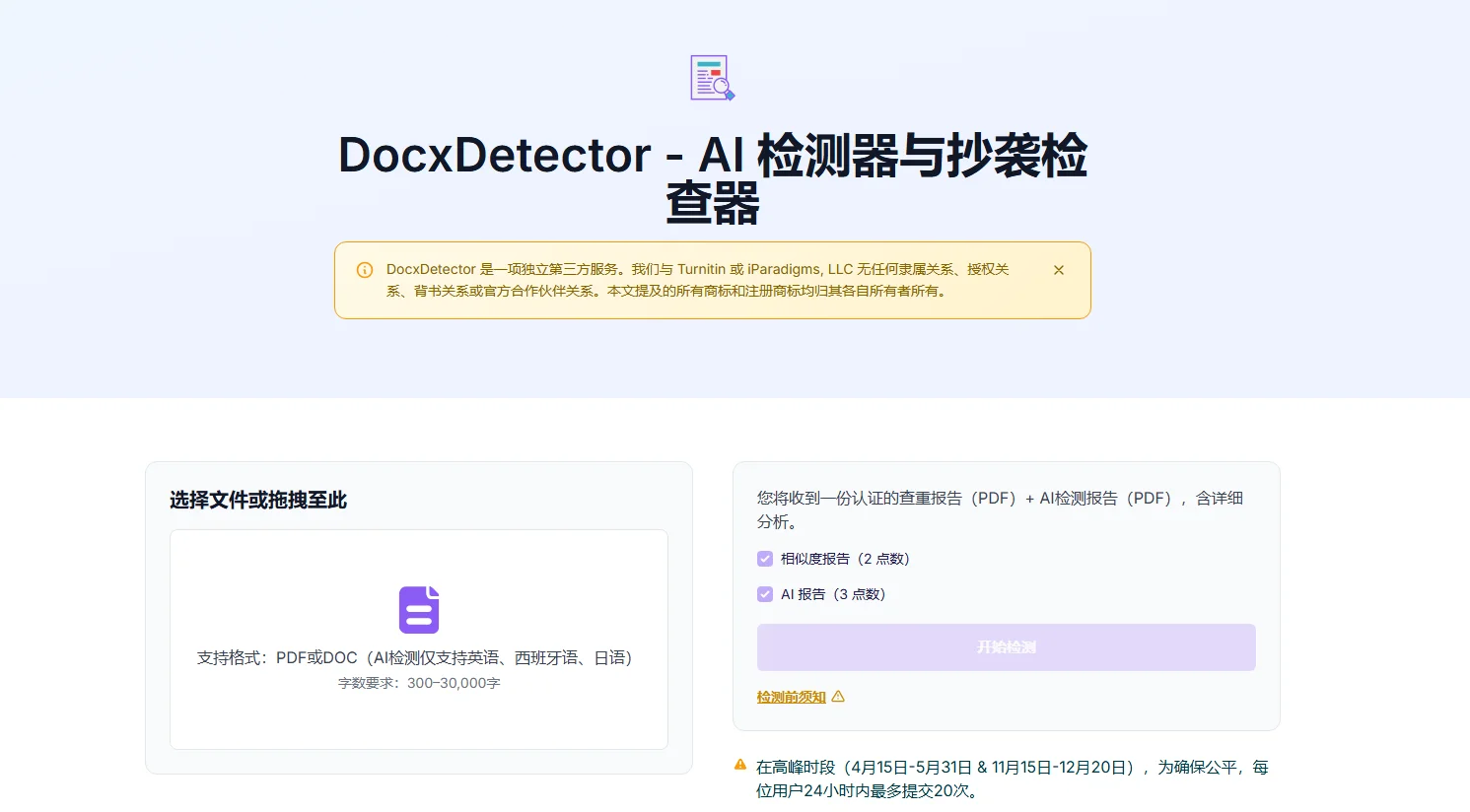
The service we provide (docxturnitin.com / DocxDetector) operates according to the above standards: Using official Turnitin educator accounts configured for no storage, issuing two PDF reports—similarity report and AI detection report; manuscripts are not added to Turnitin database, reports automatically deleted within 24 hours. It should be noted that we are an independent third-party service with no affiliation, authorization, or partnership with Turnitin or its parent company.
VII. Self-Check Checklist for Chinese Users (Recommended to Follow Directly)
Before Submission
- Delete cover pages, names, student IDs, school identifiers, and other identifiable information;
- Confirm school/instructor policies on AI use: Is it allowed? Is declaration required? What's the upper limit?
- Self-check once first to obtain baseline data, rather than passively waiting for results after submission.
After Receiving Report
- Don't just stare at that percentage.
1%-19%displays as*%; official sources explicitly state this range has relatively higher false positive rates, and*%is an acceptable range in many schools; - Look at specific blue-highlighted sentences, verify sentence by sentence: Was it AI-written? Formulaic phrasing? Or your own standardized academic expression?
- Note: Tables, lists, code, poetry do not participate in AI assessment; "percentage and highlight count mismatch" will occur; this is normal.
After Revision
- Must re-test. AI assessment aggregation methods affect other paragraphs; changing one part may cause assessment changes elsewhere;
- Don't迷信 "AI reduction tools." Rewriting the same meaning in your own language is often more effective than multiple rounds of AI rewriting and better preserves argumentative logic;
- Retain writing process evidence: Outlines, draft versions, Word revision history, annotation exchanges with advisors. These are the most powerful appeal materials if questioned.
If Misidentified
- Raise objections through school-designated degree review/academic review channels (the "Degree Law" clarifies review mechanisms);
- Submit writing process materials, not just arguing "I really didn't write it."
VIII. Frequently Asked Questions
Q1: Does Turnitin AI detection support Chinese?
No. AI writing detection currently only supports English, Spanish, Japanese, and Arabic. Chinese submissions will not generate AI reports.
Q2: Can Chinese papers still use Turnitin for plagiarism checking?
Yes. Similarity (plagiarism) detection supports 176+ languages, including Chinese. But AI percentage reports will not be generated.
Q3: Why wasn't my AI detection report generated?
Common reasons: Language not in supported list, body text insufficient 300 words continuous long-form, exceeding 30,000 words, file too large or format non-compliant (only .docx/.pdf/.txt/.rtf).
Q4: What does *% on the report mean?
Turnitin displays AI percentages of 1%-19% as *% to indicate this range has lower reliability. 0% and ≥20% display specific numbers.
Q5: Can free AI detection replace Turnitin?
No. Different detectors use different models; scores cannot be directly converted.
Q6: Will I be judged as plagiarizing because of self-checking?
This risk only exists when submitting manuscripts to channels that "store in database." Choose channels explicitly "no database storage" and don't repeatedly submit to multiple platforms of unknown origin.
Q7: Is Turnitin's AI score the final conclusion?
No. Turnitin official has repeatedly emphasized that AI indicators are only reference information for educators and should not be the sole basis for disciplinary action or grading. It's a "signal requiring review," not a "verdict."
Q8: Why are more and more sellers now providing fake reports?
Because Turnitin's risk control is strengthening: Educator accounts are more easily suspended or throttled, and reports carry traceable account and timestamp information. Sellers who cannot produce genuine reports, to avoid refunds, turn to photo editing, template套用, or impersonating with other engines. See Section IV for identification methods: Request complete PDF originals, verify display rules and content consistency, re-test through different channels if necessary.
Q9: How to judge whether a Turnitin report is forged?
Check three points: First, whether there's a complete PDF original rather than screenshots; second, whether AI percentages falling in 1%-19% display as *% (displaying precise decimals is basically fake); third, whether filenames, word counts, and highlighted sentences in the report correspond word-for-word with your manuscript. The official record within the school's system is ultimately authoritative.
IX. Final Thoughts
The real change brought by AI detection isn't "adding another software review layer," but that the writing process itself is beginning to be recorded and scrutinized. For Chinese users, the most pragmatic strategy is three sentences:
- Clarify which system you're facing—Chinese papers check CNKI/Weipu/Wanfang, English papers and study abroad assignments check Turnitin; don't mix and compare scores;
- Self-check early, but only use no-database-storage channels—The purpose of self-checking is to discover problems and revise, not create new risks;
- AI can be the co-pilot, but you must hold the steering wheel—Retain outlines, drafts, and revision traces, making "I wrote this paper" verifiable.
Disclaimer: This article is informational compilation; all third-party data is based on sources mentioned above; Turnitin's product features, supported languages, and institutional adoption may update at any time; refer to official documentation and your institution's specific regulations. This article does not constitute legal or appeal advice regarding academic misconduct.
Tags: #Turnitin #TurnitinAIDetection #TurnitinDetector #AIGCDetection #InternationalStudents #PlagiarismCheck #AIWritingDetection #AcademicIntegrity #CNKIAIGC #TurnitinAIinChina