Turnitin AI Score Asterisk: Why You See *% Not a Number

A score between 1 and 19 percent appears as an asterisk with no number and no highlights. Turnitin hides that band because false positives are more common there. Here is what the symbol means and what to do next.
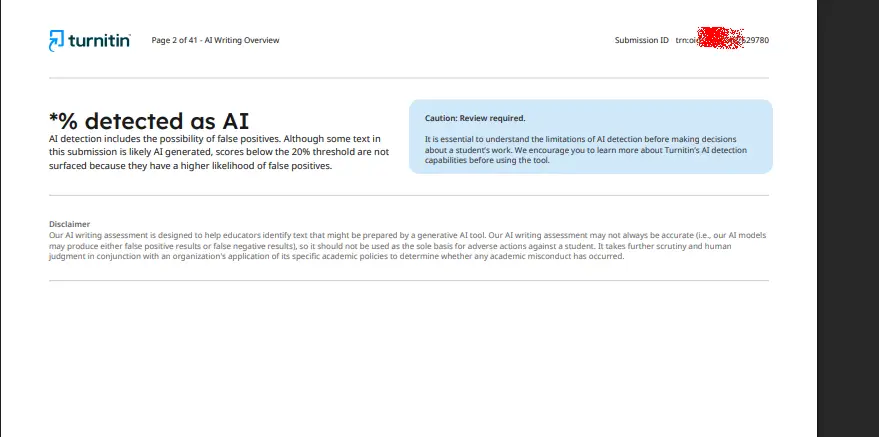
What the asterisk means
The asterisk reports a range, not a point. It means Turnitin found some signal of AI writing, but not enough to show a percentage or highlight sentences.
The hidden number sits between 1 and 19 percent. Nothing in the report tells you where in that range your document falls.
No text is highlighted either, because highlights only come with a percentage. So the report gives you nothing to click and nothing to fix by line.
That is the whole feature: one symbol replaces a number Turnitin does not trust.
On a phone screen the symbol is easy to miss. Open the AI writing section rather than the summary card to find it.
Why Turnitin hides the number
Short or formulaic text can trip the detector without any AI involvement. A methods section, a lab report or a translated abstract often reads uniform enough to score.
Showing 4 percent would imply a precision that does not exist. The asterisk says the signal is too weak to act on.
Turnitin says its false-positive rate is under 1 percent for documents with more than 20 percent AI writing. That figure describes strong signals, not the low band.
Read the claim carefully. Confidence grows when there is more machine-written text to find.
The same logic applies to a few borrowed lines inside a long essay. Small amounts of text rarely lift a whole document into the high band.
The asterisk is not a zero
Students often read the symbol as a clean result. It is not. It is a low-confidence flag with the percentage withheld.
A true zero appears as 0 percent in plain numbers. The two look different on purpose and they are not interchangeable.
If you need a number you can act on, run the same document through a check that reports the full percentage.
A low-confidence flag often disappears after one rewrite. Two edited paragraphs can move a document out of the band entirely.
Why your tutor may still ask
An asterisk is not a charge and it is not evidence. Your tutor still sees your drafts, your sources and your ability to explain the work.
Keep your notes and earlier versions. A dated file with your own rough phrasing answers the question faster than any argument you can make in a meeting.
If a meeting happens, ask which passages triggered the check. Specifics turn a vague worry into a conversation about two paragraphs.
How to turn it into a usable number
Rewrite the passages that read most evenly, then run the check again. Varying sentence length usually moves the score more than swapping synonyms does.
A paid pre-submission check returns the full AI report, including any percentage and highlights. That gives you something to fix instead of a symbol to worry about.
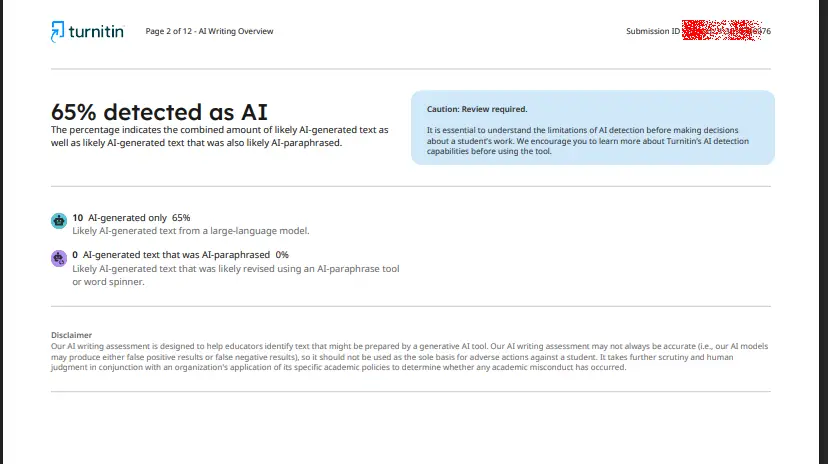
Compare the two reports side by side. If the number falls, keep the edit. If it rises, revert it.
For how the detector works, read the Turnitin AI detection guide. For the score itself, see understanding Turnitin detectors.
If the flagged writing was your own, Turnitin flagged your own writing as AI lists the seven usual causes.
FAQ
Does an asterisk mean 0 percent?
No. It covers 1 to 19 percent, with the exact figure hidden from the report.
Can highlights appear next to an asterisk?
No. Highlights only appear when Turnitin shows a percentage, so an asterisk gives you no marked sentences.
Will my tutor see a number?
No. Everyone who opens the report sees the same asterisk and the same missing highlights.
Check your paper before you submit — you get a similarity score and an AI score in one report.