Turnitin False Positive: 7 Reasons Your Writing Looks AI

A Turnitin false positive happens when your own writing matches the pattern the detector expects from a machine. Scores from 1 to 19 percent are hidden behind an asterisk for that reason. Here are seven causes and what to do about each.
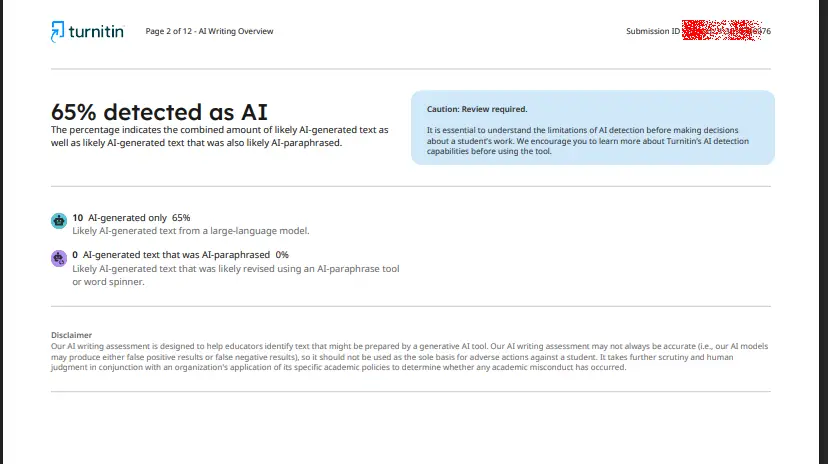
The seven patterns that trigger it
Most flagged drafts share the same habits. None of them proves that a machine wrote the text.
- Every sentence runs to the same length and rhythm.
- Transitions are tidy and interchangeable.
- Heavy paraphrasing strips your own phrasing.
- Translation tool output flattens idiom.
- Bullet points are expanded into full prose.
- A grammar tool has smoothed every rough edge.
- Thin citation makes the text read like a summary.
Read that list as a style audit. Each item is something you can change in an afternoon.
You do not need all seven. Two or three together can push a short section into the machine-like range.
Why non-native writers get hit hardest
A Stanford study in 2023 tested seven generic AI detectors on TOEFL essays written by non-native English speakers. The detectors flagged 61.22 percent of those essays as AI.
That was not a Turnitin test, so do not read it as proof that Turnitin misreads your work. It does show how much detectors depend on style rather than substance.
If you write in a second language, your clean, careful prose can look machine-made. That is a weakness of the tool, not of your writing.
What the asterisk really means
When Turnitin shows an asterisk instead of a number, the score sits somewhere between 1 and 19 percent. No highlights appear, because the signal is weak.
Turnitin says its false-positive rate is under 1 percent for documents that contain more than 20 percent AI writing. That claim covers strong signals, not the low band.
Students often assume the symbol means zero. It does not, and the difference decides whether you rewrite anything.
Turnitin explains the asterisk rule in its own AI detection FAQ, which is worth reading before you argue with anyone.
What to change before you resubmit
Vary your sentence length on purpose. Put a nine-word sentence next to a twenty-five-word one and read the page aloud.
Replace the generic transitions with something specific to your argument. A transition that only works in your paragraph is harder to mistake for machine text.
Add your own evidence: a data point from your lab, a quotation from a source you read, a caveat you noticed. Detectors have no way to score material that only you could have written.
Rewrite the most even paragraphs by hand, from memory, without looking at the original. The awkward phrasing you produce is the point.
Keep a copy of the version you changed. If the score moves, you want to know which edit did it.
How to push back with evidence
Keep your drafts, your reading notes and your outline. Version history with timestamps answers a false-positive question faster than any explanation.
Ask which passages were flagged. A specific paragraph turns a vague accusation into a conversation you can win.
Save your source PDFs and screenshots of your search history. A reading trail is evidence; a protest is not.

For the mechanics behind the score, read the Turnitin AI detection guide. For the asterisk itself, see why Turnitin shows an asterisk instead of a number.
To cut the risk before you submit, use these seven strategies for avoiding an AI flag.
FAQ
Can Turnitin flag human writing as AI?
Yes. Low-confidence scores are shown as an asterisk because false positives do occur, especially in short or formulaic text.
Does an AI flag mean I will fail?
No. It is a signal for your tutor to look closer, not a verdict. Your drafts and notes are the evidence that matters.
Should I rewrite everything if I get flagged?
No. Start with the highlighted passages and the paragraphs that read most evenly, then check again.
Check your paper before you submit — you get a similarity score and an AI score in one report.