Turnitin Clarity: The Writing Transparency Tool Reshaping How Schools Handle AI

For more than two decades, Turnitin has been the name universities reach for when they want to check whether a student's paper is original. More than 16,000 institutions in over 140 countries use its platforms, making it the dominant academic-integrity brand in the world.
But the ChatGPT era changed the rules. A traditional similarity check tells you if text matches something already published — it says nothing about whether the student actually wrote the words. So in 2025, Turnitin introduced something genuinely different: Turnitin Clarity.
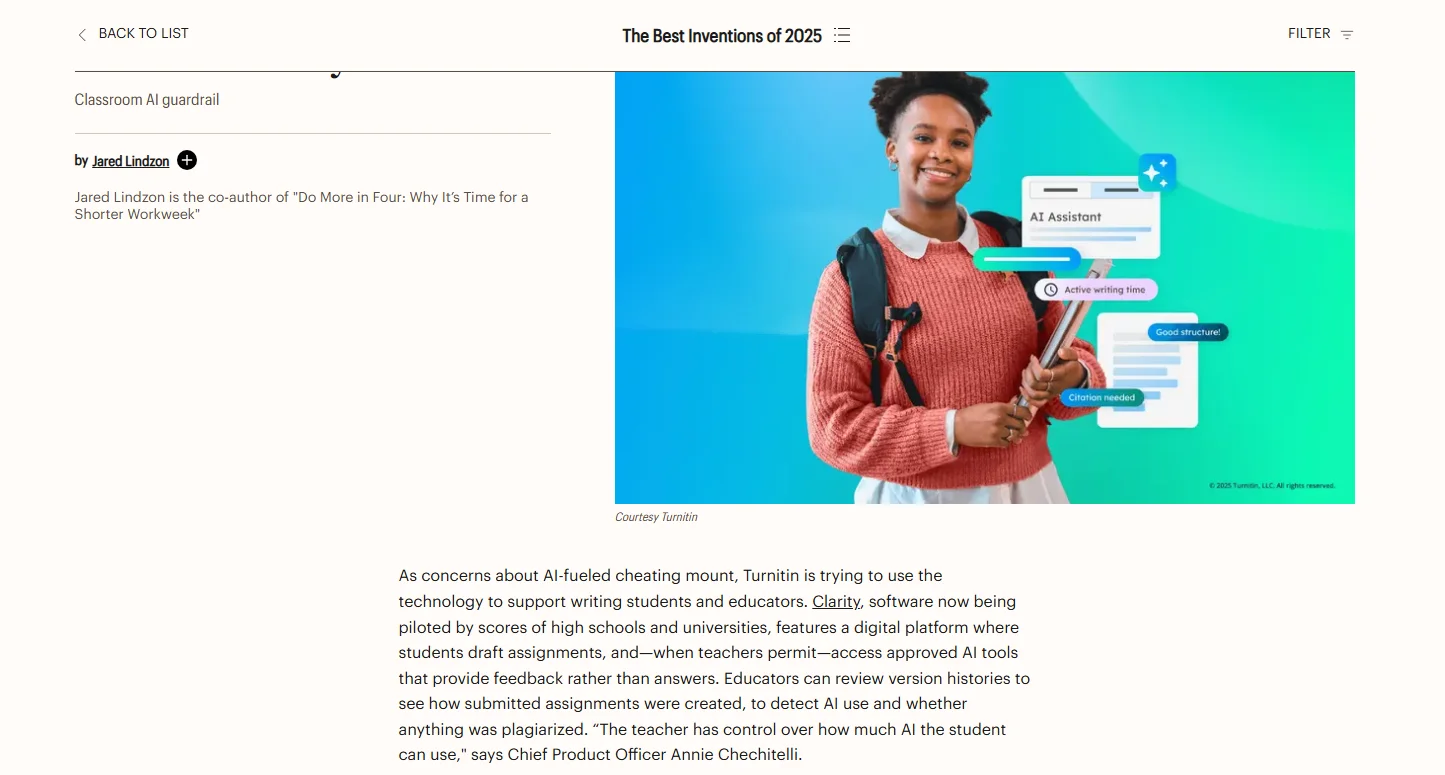
Named one of TIME's Best Inventions of 2025, Clarity is not really an "AI detector" at all — at least not in the way most people imagine. Instead of inspecting a finished paper for suspicious fingerprints, it watches the writing happen. It records how a document evolves: when text is pasted, how much time is spent, how the drafts change. The idea is to replace the guesswork of AI detection with something educators have been asking for for years — a transparent view of the student's actual writing process.
This article explains what Clarity is, what it does well, where it falls short, who is using it, and what students and educators are saying about it in 2026.
What Is Turnitin Clarity?
Turnitin Clarity was announced at SXSW EDU in Austin, Texas, on March 4, 2025, and became available as a paid add-on to Turnitin Feedback Studio in the third quarter of 2025. It was expanded to Spanish-speaking markets in May 2025 and, in October 2025, earned a place on TIME's annual list of the Best Inventions of 2025.
At its core, Clarity is a "writing transparency" tool. Students compose their assignments inside a dedicated writing space that lives within their institution's existing learning management system (LMS). As they work, the system captures the evolution of the document — the sentences added, the paragraphs rewritten, the large blocks pasted in, the session-by-session progress.
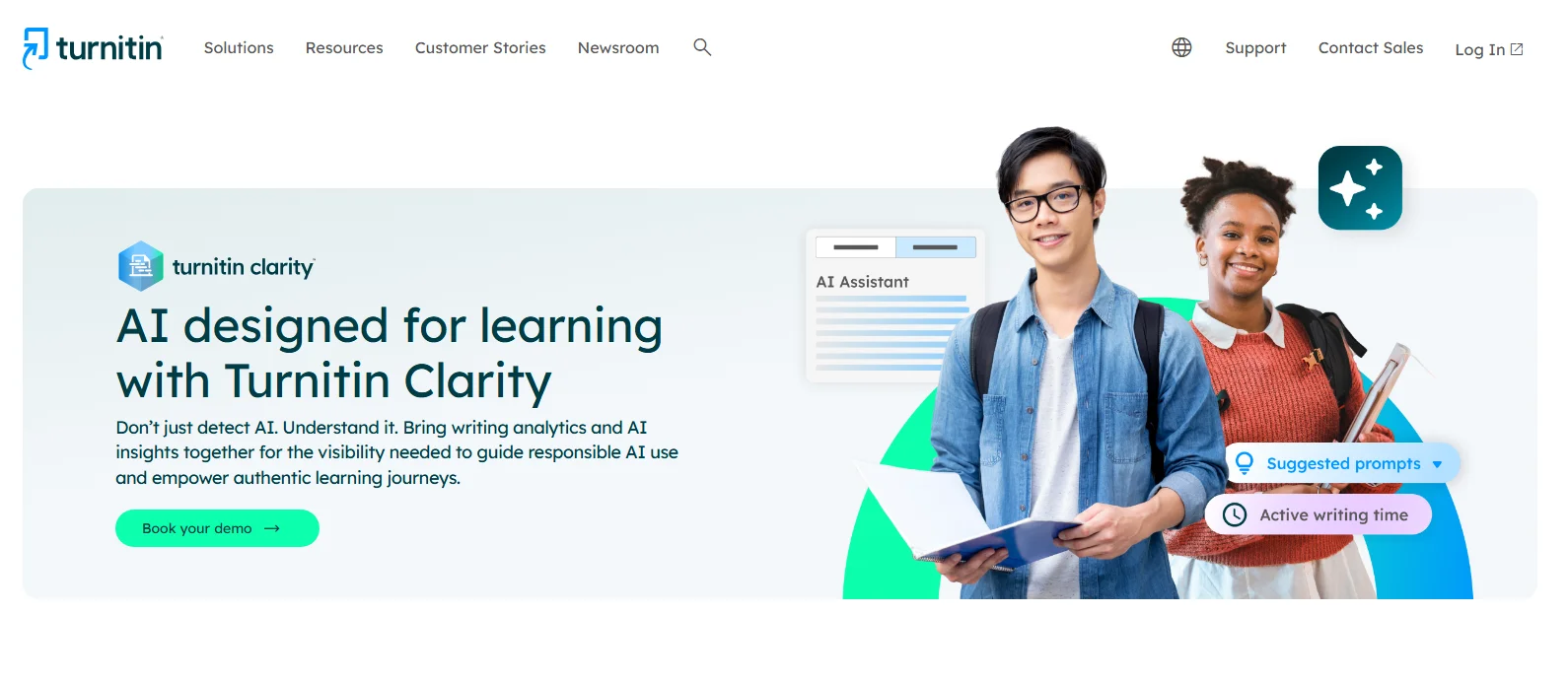
When a student submits, the instructor doesn't just see the final paper. They see a Writing Report that includes:
- A timeline of the writing process, including typing patterns and construction time
- Draft history and playback, showing how the document changed over time
- Flags for pasted text and other moments that may warrant a closer look
- Integrity insights in one place: similarity checking, submission metadata, grading and feedback — and, when the institution also licenses Turnitin's Originality add-on, AI writing detection
The insight the company is leaning on: AI-generated text tends to appear as large pasted blocks with little subsequent editing, while human writing usually builds incrementally — sentences added, deleted, restructured, revisited days later. The timeline makes that distinction visible.
The AI Tools
Clarity also includes a set of AI-powered tools that instructors can enable per assignment:
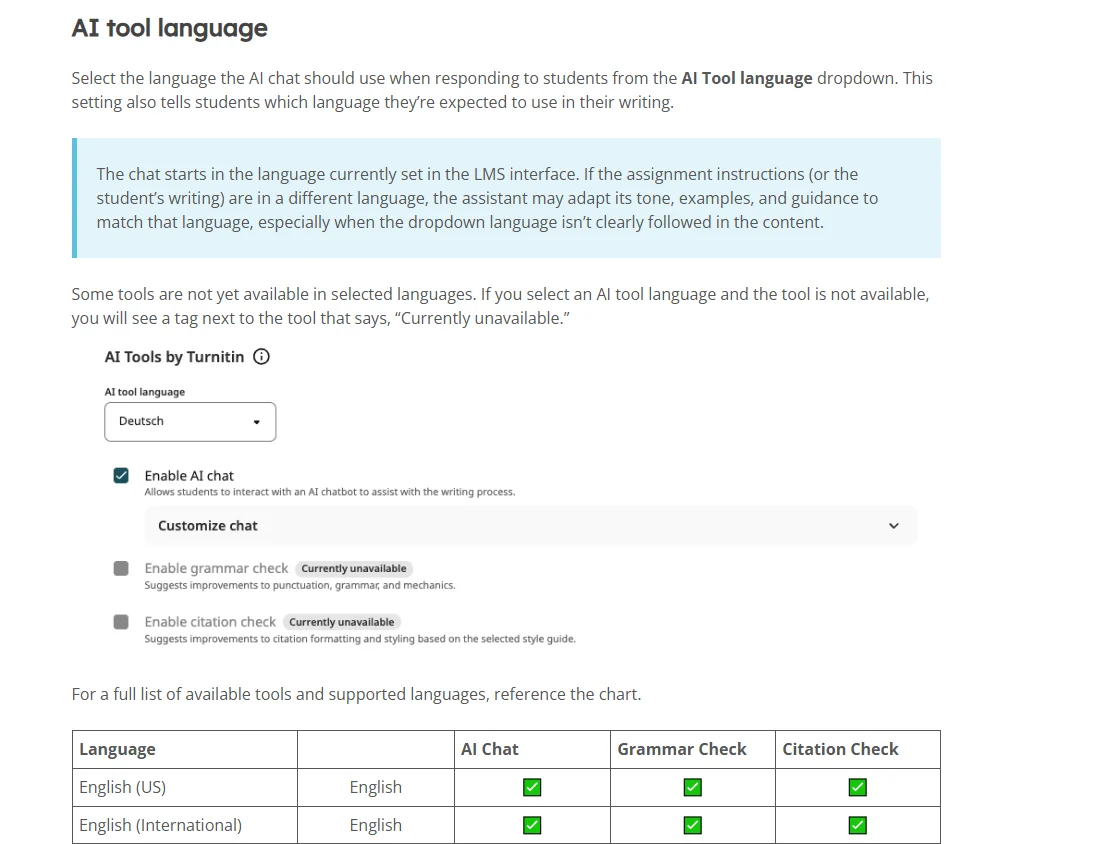
- AI chat. Powered by Anthropic's Claude models (Claude 3.5 Haiku in North America; Claude 3.5 Sonnet in Europe and Asia-Pacific), the assistant answers questions about the assignment, gives feedback on grammar, citation, organization, and argumentation, and guides students through suggested prompts organized by writing stage — getting started, drafting, reflecting, proofreading, and follow-up. It refuses to write the work itself: Turnitin's guidelines state it "should not complete assignments for students." Students can select up to 1,000 characters of their own text to request feedback on, and each chat is capped at 250 messages. The assistant supports more than 20 languages — from German, Spanish, and French to Korean, Japanese, Arabic, and Chinese — though only English (US and International) currently gets full grammar and citation checking.
- Spelling and grammar check. Usable any number of times before the due date, offering suggestions for punctuation, grammar, and mechanics.
- Citation check. Reviews in-text citations and references against the style guide chosen when the assignment was created — currently MLA (9th ed.), APA (7th ed.), Harvard (following Cite Them Right, 12th ed.), and Chicago/Turabian.
Crucially, all interactions with the AI tools are logged. A banner in the chat reminds students that instructors will see their entire chat history upon submission. After the due date, instructors can open the "AI Chat Activity" view in the Writing Report, which shows how each student used the assistant: a full chat transcript, themes grouped by writing stage (Getting Started, Drafting, Researching, Reflecting, Proofreading, Other), and an AI-generated summary called "Here's how the student used AI."
Turnitin adds an important caveat: that summary is itself produced by a generative AI tool and "may make mistakes or be incomplete." Turnitin advises instructors not to rely on it as the sole source of truth.
In May 2026, Turnitin added more granular controls, letting instructors configure how helpful the assistant is — from planning and brainstorming support to sentence-level revisions and proofreading — and choose response complexity (Foundational, Standard, or Advanced) to match student maturity.
In a November 2025 update, Clarity also began flagging pasted blocks of text longer than 300 words that appear to have been written or altered by AI, showing an overall AI percentage and a breakdown of "likely AI-generated," "likely AI-bypassed," and "likely AI-paraphrased" text. Students can now choose between US and UK English.
The Pros: Why Many Educators Are On Board
1. Transparency instead of accusation. The biggest shift is philosophical. Instead of a black-box percentage that says "this looks like AI," Clarity gives instructors the process itself. A student who wrote for 14 hours across six sessions has a visible story; one who pasted an 800-word block in the final hour has a different story. Turnitin's Chief Product Officer, Annie Chechitelli, calls Clarity "a bridge between students and educators."
2. Fewer false positives — at least in intent. Turnitin's original 2023 AI detector was widely criticized for flagging non-native English speakers and formulaic writers. Clarity's process-based evidence is much harder to argue with, and Turnitin has also retrained its detection models — an August 2025 algorithm update that independent reviewers found cut false-positive rates by roughly 40%.
3. A conversation starter, not a verdict. Educators keep repeating the same point: the Writing Report is meant to open a dialogue, not to launch a misconduct hearing. A teacher can say "help me understand this paragraph" rather than "you used ChatGPT."
4. It saves time. Turnitin's own data, released in February 2026, showed educators using Clarity's AI assistant to handle the constant stream of routine questions students ask — about citation, style, and structure — freeing instructors for higher-level teaching. They also reported more consistent, timely feedback.
5. It teaches responsible AI use. Because the assistant is bounded and logged, students can experiment with AI inside guardrails and learn how to use it well — a skill they will need in almost any career.
The Cons: Legitimate Concerns That Remain
1. It's still surveillance, and it's uncomfortable. Many students see keystroke logging and process playback as monitoring, not support. Writing in a space where every paste and every pause is recorded can feel like writing under a camera. Privacy advocates, particularly in Europe, have raised questions about how student writing data is stored and used.
2. It doesn't eliminate false positives. Clarity adds process evidence, but it does not replace AI detection — and detection still misclassifies text. A Stanford study found that 61.22% of TOEFL essays written by non-native English speakers were flagged as AI-generated by detectors. Turnitin itself acknowledges a small false-positive risk.
3. It's a paid add-on. Clarity requires a separate license on top of Feedback Studio, and AI writing detection requires yet another add-on (Originality). That means access depends on institutional budgets — a potential equity gap between well-funded universities and smaller colleges.
4. It's not a complete defense against determined misuse. Students can do their drafting outside the tool and paste in polished text, or run AI output through "humanizer" tools. The arms race between detection and evasion continues.
5. It doesn't fix the policy vacuum. Clarity provides evidence, but it doesn't tell instructors what to do with it. Without clear institutional policies on what counts as acceptable AI use, individual teachers are left to improvise — which students experience as inconsistency and unfairness.
Which Schools Are Using It? How Widespread Is Adoption?
Because Clarity is a paid add-on, Turnitin does not publish a simple "number of schools using Clarity" figure. Here's what we do know:
- Turnitin's base platforms are used by more than 16,000 institutions in over 140 countries — including a large share of universities in the US, UK, Australia, and Canada.
- Clarity has been rolling out since Q3 2025, and Turnitin says adoption accelerated through 2025–2026 as institutions looked for answers to the false-positive problem.
- Public references to actual deployments are still emerging. O'Fallon Township High School in Illinois features in Turnitin's customer stories, with district official Jennifer Lara quoted as saying: "Without [Turnitin] Clarity, you're missing an entire piece of the composition process. We would be greatly disadvantaged if we didn't have that window into a student's process." The University of Lisbon (ULisboa) in Portugal has referenced Clarity as part of its anti-plagiarism infrastructure transition.
The pattern across regions is uneven. Adoption is strongest in North America, the UK, and Australia, where Turnitin is deeply embedded in university workflows. Continental Europe is more cautious, partly because of GDPR sensitivities. And a notable counter-current has emerged: as of 2026, at least a dozen major universities — one independent tracker counts sixteen — have disabled Turnitin's AI detection feature entirely, citing false positives and bias against non-native English speakers. Clarity's process-based approach is, in part, Turnitin's answer to that backlash.
The short answer to "are schools using it a lot?": the infrastructure is there — nearly every Turnitin subscriber can turn it on — but real usage varies enormously from department to department. Some instructors consult the Writing Report routinely; others treat it as an occasional check; a minority refuse it on principle.
What Students Are Saying
Student reactions range from cautious appreciation to outright fear.
The anxious majority. The dominant sentiment is anxiety. International and non-native English speakers are the most worried, and with good reason: the Stanford research above showed how often authentic student writing gets misclassified. Stories like that of Kelsey Auman, a University at Buffalo student falsely accused of using AI who launched a petition against the system, circulate widely on Reddit and TikTok. "I spent three weeks on my thesis chapter, wrote every word myself, and still got flagged" is a recurring theme in student forums.
The "prove you wrote it" problem. Even under Clarity, a flagged submission can shift the burden of proof onto the student. Students report being asked to "explain their writing process" in formal meetings — humiliating even when the case is eventually dropped.
The surveillance concern. Some students describe the process recording as a "digital ankle monitor" for writing. They worry that being watched changes how they write — and that the tool punishes the very drafting behavior (pasting notes, reorganizing later) that normal writers exhibit.
The cautiously accepting minority. Not all feedback is negative. Some students — particularly those who put in the work — welcome the deterrent effect. As one commenter put it: "It's annoying to think someone can generate a paper in 30 seconds and get the same grade. If this levels the field a bit, I'm okay with it." Turnitin's own data found that nearly a third (29%) of student prompts to the AI assistant were requests for feedback — "Is this good?" "What can I fix?" — suggesting many students genuinely want guidance, not shortcuts.
What Educators Are Saying
Instructor opinion splits along philosophical lines.
Supporters. Teachers in large first-year courses and writing-intensive programs are often enthusiastic. "I have 120 students per section," one composition instructor told an education outlet. "I can't read every paper with the forensic attention needed to spot AI writing. Clarity tells me where to look more carefully." The AI assistant is also popular: Turnitin's February 2026 data showed educators praising it for saving time, improving feedback consistency, and showing students how to use AI responsibly rather than simply banning it.
Skeptics. Other educators refuse to outsource judgment to an algorithm, or worry that less experienced colleagues will treat the Writing Report as gospel. Others question the entire premise: "Every semester, the detection gets better, and the evasion gets better," one senior lecturer said. "I'd rather invest that energy in redesigning assessments — oral defenses, in-class writing, process portfolios — so it doesn't matter whether a student used AI."
The policy gap. A recurring complaint across faculty forums is that universities adopted the tool without adopting a policy. Instructors report having no clear guidance on what counts as acceptable AI use, no training on how to interpret Writing Reports, and no defined appeals process for students who are flagged.
Impact on Academic Integrity
Clarity represents a genuine shift in how academic integrity is enforced — from detection to evidence.
The positive case. Process transparency deters casual, wholesale AI generation, because the paper trail is visible. It also replaces vague suspicion with a concrete artifact — a timeline that instructor and student can sit down and discuss together. And it signals that institutions take responsible AI use seriously, reinforcing norms.
The legal and policy pressure. The stakes are higher than reputation. In early 2026, the Newby v. ECU case established that institutions can face real legal liability for academic integrity actions based primarily on AI detection scores. At the same time, the EU AI Act's Article 50 transparency obligations — taking effect in August 2026 — require labeling of AI-generated content, pushing institutions toward documented, auditable processes. In that light, Clarity's process data acts as a form of liability protection: it provides evidence that a decision was based on something more than a probability score.
The uncomfortable questions. Clarity doesn't answer the deeper question: what counts as "cheating" in the AI era? Is using AI to brainstorm an outline acceptable? What about improving transitions, or checking grammar? Clarity can show that AI was used; it cannot adjudicate intent or degree of reliance. That judgment remains human — and it remains contested. Critics also worry that process monitoring erodes the trust that genuine learning depends on, turning every essay into an audit.
The emerging consensus among academic-integrity professionals is that tools like Clarity should be one input among many, never the sole basis for a misconduct finding. Institutions that pair the tool with AI literacy programs, clear use policies, and redesigned assessments report far better outcomes than those that treat it purely as policing.
Impact on AI Writing
Perhaps the most interesting effect of Clarity is how it is changing behavior around AI — on both sides of the desk.
Students are adapting. Surveys and Turnitin's own data suggest students are shifting from full-text generation toward AI-assisted ideation, outlining, and revision — in part because process tracking makes wholesale AI text more visible. Turnitin reported that since October 2025, about 15% of English essay submissions had more than 80% AI-generated writing — up from an average of 3% when its detector launched in April 2023. The problem isn't going away; it's concentrating.
The "humanizer" industry. A cottage industry of AI humanizers and paraphrasing tools has grown up specifically to evade detection. Turnitin has responded by training its models to spot paraphrase and bypass signatures, and it has publicly pushed back on claims that any tool can make AI output reliably undetectable. But the cat-and-mouse game continues — and the students most likely to be caught are those using free, naive tools, which raises equity concerns of its own.
Assessment is being redesigned. The most promising development is that Clarity is pushing educators to rethink how writing is taught and assessed. Drafts, reflection memos, in-class writing, oral defenses, and portfolio assessments are becoming more common. Some courses now explicitly assign AI use and ask students to critique and annotate the output. In these classrooms, Clarity stops being a gotcha tool and becomes a teaching tool.
Disclosure norms are emerging. Just as citations became standard practice, "I used [Tool X] for [Purpose Y]" is becoming a normal part of academic work. Turnitin's Clarity data — showing that students are hungry for feedback and guidance — suggests many students want to use AI ethically; they just don't know where the line is.
The Bottom Line
Turnitin Clarity is best understood as a transitional technology. It exists because the academic world was caught off guard by generative AI and needed a way to restore confidence in student work. Whether it succeeds will depend less on the technology itself and more on how institutions choose to use it.
- If you're a student: understand that Clarity is not omniscient. Keep your drafts, document your process, and know your institution's AI policy. If you're flagged, you have the right to a conversation — and process evidence can work in your favor.
- If you're an educator: treat the Writing Report as a starting point, not a verdict. Invest in assessment design that makes detection less central, and advocate for clear policies so you're not improvising alone.
- If you're an administrator: pair any deployment with training, transparency, and a robust appeals process. The tool is only as fair as the system around it.
Clarity is not the villain, and it's not the savior. It's a mirror — reflecting how a generation of educators and students are trying to figure out what authentic writing means in a world where the boundary between human and machine authorship is blurrier than ever.
How we choose to use it will matter more than the tool itself.