Self-Plagiarism and Turnitin: Reusing Your Own Work

Turnitin will match your previous paper because that paper sits in the student paper database. Reusing your own text without citation is self-plagiarism, and most institutions treat it as a form of academic misconduct. The fix is citation and disclosure, not a quiet rewrite.
Why your own work shows up as a match
Papers submitted to Turnitin are stored in a repository and compared with later submissions. Your earlier essay can therefore appear as a source in your new report, with a date and a title.
The match is real. The question your institution asks is whether you were allowed to reuse that text.
When reuse is acceptable
Some reuse is normal in research. A methods section, a definition, or a short passage from your own published work can be reused when you cite it.
Rules differ by institution, so check your handbook. Many departments require a citation plus a short note that the material appeared in earlier work.
- Cite the earlier paper as you would cite anyone else.
- Quote your own wording when you keep it word for word.
- Tell your instructor if a chapter overlaps with a previous submission.
When it becomes a problem
Submitting the same essay to two courses without permission is the clearest case. So is padding a new paper with long blocks of an old one to reach a word count.
Turnitin states that a high similarity score does not by itself prove plagiarism. Your institution makes that judgement, and context matters more than the number.
Short overlaps, such as a standard method description, are common and rarely a problem. Long unmarked blocks are what reviewers notice.
How to check before you submit
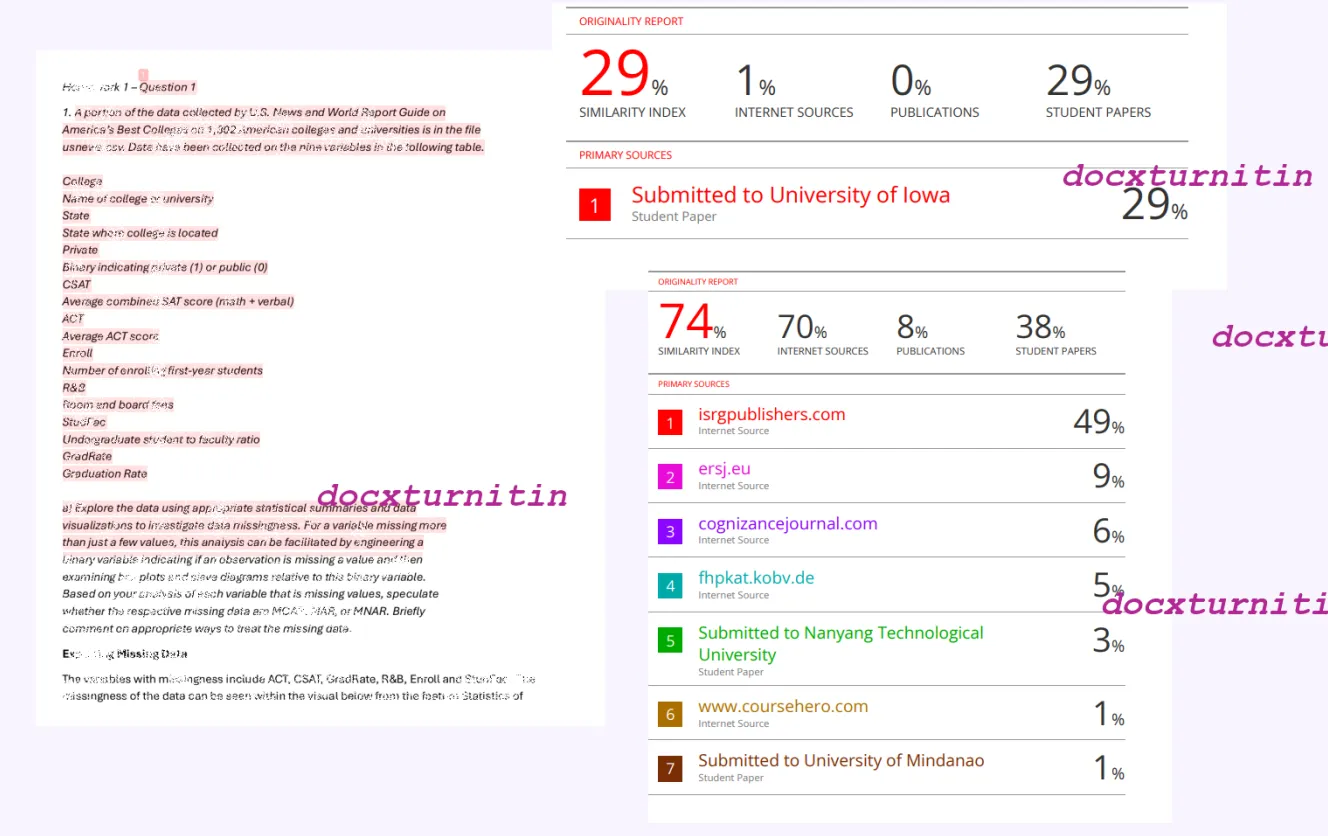
Run your draft and open the sources list. A single source with a large match and an old date is often your own prior work. Read the highlighted passage and decide whether it needs a citation.
For the general question of what score to aim for, see what a good Turnitin similarity score looks like. The score is a starting point, not a verdict.
How to cite reused text
Use the same style as the rest of your paper, and name the earlier work in the sentence itself. A citation buried in the reference list is weaker than a sentence that states the reuse.
If the earlier text was AI-generated, the citation rules change. Our guide to citing ChatGPT in APA, MLA and Harvard explains how to name a model and a version.
What happens if a marker finds it
A marker who spots a self match will usually ask for the earlier paper and your permission trail. If you disclosed the reuse, that conversation is short.
If you did not, the case can move to your institution's misconduct process, where intent is one of the questions they test.
Save each version with a date, and keep the file you actually submitted. If a match is questioned later, that record shows what you wrote and when.
It also helps you spot your own recycled paragraphs before a marker does.
FAQ
Is self-plagiarism the same as plagiarism?
Most policies treat it as a related offence with a separate name. The penalty depends on your institution and on whether you disclosed the reuse.
Can Turnitin tell that the source is my own paper?
It can match the text, but it does not label the author of the source. Your instructor reads the match and decides.
Should I rewrite my old text to avoid a match?
Rewriting hides the reuse without fixing it. Cite the earlier work or ask for permission to reuse it.
Check your paper before you submit — you get a similarity score and an AI score in one report.