Turnitin AI Detection Languages: Which 7 Are Supported?

Turnitin's AI detector supports seven languages: English, Spanish, Japanese, Arabic, German, Dutch and Turkish. German, Dutch and Turkish were added on 6 October 2026. Submit in any other language and you get a similarity report, but no AI percentage.
The Seven Supported Languages
The list is the whole set. There is no partial support and no hidden beta tier waiting for you to find it.
- English
- Spanish
- Japanese
- Arabic
- German, added 6 October 2026
- Dutch, added 6 October 2026
- Turkish, added 6 October 2026
Coverage has grown over time. The Turnitin announcement confirms the three languages added in October 2026.
Why English Works Differently
Only the English detector includes AI paraphrasing and AI-bypasser detection. Spanish and Japanese detectors do not. A paraphrased paragraph can therefore score differently depending on the language you submit.
That gap matters if you write in two languages. The same argument can look clean in one report and flagged in another, with no change to your actual drafting process.
Treat an English score as the strictest of the seven. It is the only one that looks for rewritten and humanizer-treated machine text.
If you plan to submit in Spanish, read the result as a narrower signal. That detector reports a simpler picture, because it does not look for paraphrased AI.
What Happens in an Unsupported Language
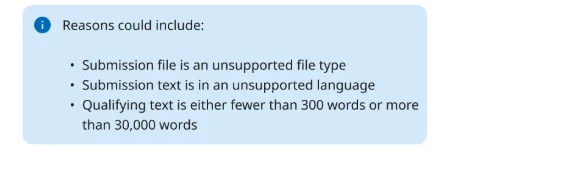
Nothing errors. The submission still produces a similarity report, because that check does not depend on the language. The AI panel simply reports that detection is unavailable.
If you write in French, Portuguese, Korean or Italian, expect a human reader instead of a percentage. Your instructor reads the text with no AI figure beside it.
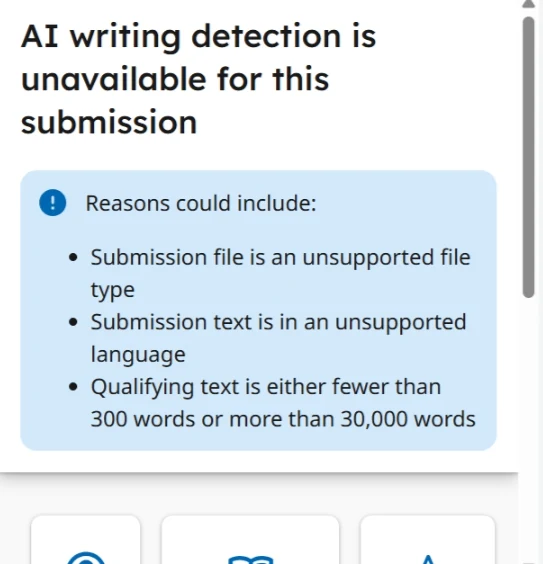
The blank panel is easy to misread as a clean result. It is not. It means the check never ran on your text.
Write down which language you submitted in. That one detail explains most missing AI scores and saves a conversation with your tutor.
Ask before you assume a blank panel is acceptable. Some tutors require an AI report and will ask for a resubmission in English.
Language Is Not the Same as Fluency
A 2023 Stanford study tested seven generic detectors on TOEFL essays written by non-native English speakers. Those tools flagged 61.22% of the essays as AI. The study did not test Turnitin, but the pattern explains why English detection needs care.
Clean, simple sentences look predictable to a classifier. Predictable text is what these models score as generated, even when a person wrote every word.
Non-native writers cannot fix this by writing worse. They can fix it by varying sentence length and sentence openings across the draft.
Where the Accuracy Stops
A supported language gets you a number, not a verdict. The detector is reliable on papers that are mostly AI-written and cautious in the low band. How accurate Turnitin AI detection is explains those limits.
The AI detection guide shows what each report panel means once the report appears.
Checks Before You Upload
Confirm two things: the language is on the list, and the word count sits between 300 and 30,000 words of prose. Why an AI report will not generate covers the file type and size rules.
If both pass and the report still does not appear, the problem is the file, not the language. Re-export it and upload again.
Submit early enough to act on the result. A missing report found on the deadline is a deadline problem, not a writing problem.
FAQ
Does Turnitin detect AI in French or Portuguese?
No. Neither language is on the supported list, so no AI report is generated. The similarity report still runs.
Can I get an AI score for a mixed-language paper?
Only if the submitted text is one of the seven supported languages. Turnitin does not publish a rule for mixing languages.
Does the Spanish detector catch paraphrased AI?
No. AI paraphrasing and AI-bypasser detection belong to the English detector only, not Spanish or Japanese.
Check your paper before you submit — you get a similarity score and an AI score in one report.