Turnitin AI Detection Accuracy: How Reliable Is It?

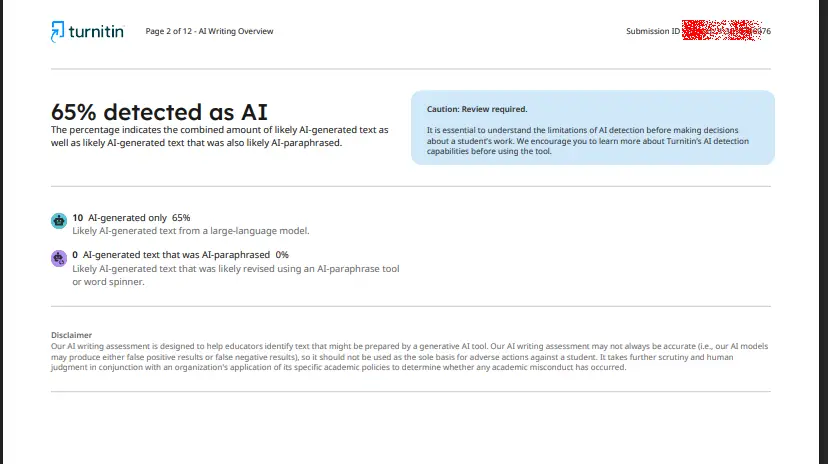
Turnitin's AI detector is reliable at the extremes and vague in the middle. Turnitin says false positives stay under 1% for documents with more than 20% AI writing. Here is what each score can and cannot tell you.
What the Detector Actually Measures
Turnitin scores each segment and estimates how likely it is to be machine-generated. It does not match your text against a database, which is what the similarity check does. The output is a probability, not a verdict.
That difference matters at the top of the scale. A 90% result describes the text in front of the tool, not the research behind it.
Where the Score Holds Up
The accuracy claim is narrow. Turnitin reports a false-positive rate under 1% for documents with more than 20% AI writing. That covers papers already carrying a lot of machine text.
On those papers the detector is useful. A high percentage usually points to real generated text, and the highlights show which sentences triggered it.
Bulk generated text leaves a pattern that a model catches and a tired reader may miss. That is the case this tool was built for, and it handles it well.
Where It Gets Shaky
Formal academic prose is the weak spot. It is repetitive by design, and that pattern looks mechanical to a classifier.
Turnitin handles this by hiding scores from 1% to 19%. In that band you see an asterisk with no percentage and no highlights, because false positives are more common there. The asterisk explained walks through that band.
A 2023 Stanford study is worth knowing. Seven generic AI detectors flagged 61.22% of TOEFL essays written by non-native speakers as AI. That was not a test of Turnitin, but it shows how detectors read clean, simple English.
Short answers, reflective writing and templated lab reports all sit in this zone. So does a methods section that follows a faculty template closely.
Turnitin answers these cases in its own documentation. The AI detection FAQ is worth reading before you argue with a score.
When No AI Report Appears
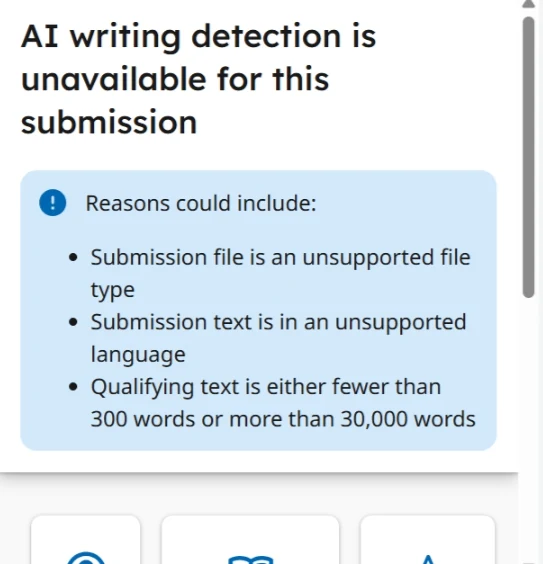
Some files get no AI score, and that is not an accuracy problem. The report needs 300–30,000 words of prose, a file under 100 MB and a supported file type. Language matters too, since only 7 languages are supported.
If your file still fails the check, the requirements list covers each reason in turn.
A missing AI score is a coverage question before it is an accuracy question. Read the panel text before you decide the tool broke.
Reading the Highlights
An overall number hides the shape of the result. A paper at 40% may hold one long generated section or twenty scattered phrases. The highlights tell you which is true.
Compare each flagged passage with your own drafts. If you wrote it, you know how the sentence changed over time. That history is your best evidence.
One flagged sentence inside a human paragraph is a common result. Treat it as a wording signal, not a confession.
What the Percentage Does Not Cover
An AI score says nothing about citation quality. The two numbers come from separate systems and do not affect each other. A paper can score 0% similarity and 100% AI, or the reverse.
It also does not tell you who wrote the text. A detector reads patterns, not authorship records, and it has no view of your notes or drafts.
If a classmate's paper scored lower than yours, that gap says less than the highlighted passages do. Compare passages, not totals.
How to Use the Number
Treat the AI score as a prompt for review, not as a grade.
- 0% means no evidence was found. It does not prove you wrote the words.
- 20% or higher sits in the range Turnitin trusts most. Open the highlights and check each one.
- An asterisk means the detector could not decide. Treat it as unresolved rather than cleared.
Keep the report beside your drafts while you revise. The pair answers most questions an instructor will ask.
FAQ
Is a 0% AI score proof I wrote the text myself?
No. It means the detector found no evidence of machine text. That clears one check, not the question of authorship.
Why does my report show an asterisk instead of a number?
Scores from 1% to 19% are shown as an asterisk with no percentage and no highlights. That band is where false positives cluster.
Does a high AI score raise my similarity score?
No. The similarity score and the AI percentage are independent and do not influence each other.
Check your paper before you submit — you get a similarity score and an AI score in one report.